Free CDL Doubles/Triples Practice Tests
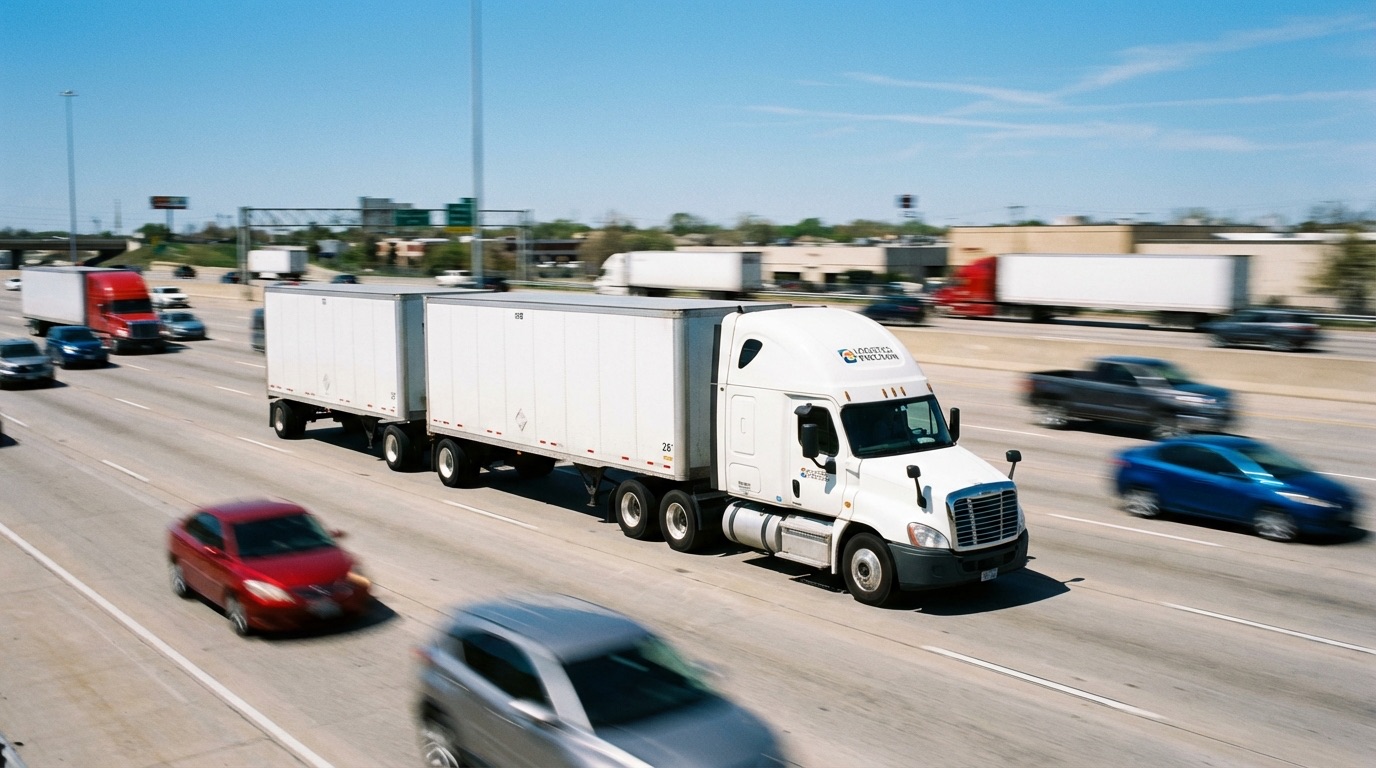
Two trailers, or three. The physics get interesting. FedEx, UPS, and the big LTL carriers want drivers who can handle them.
Small movements at the cab turn into big movements at the back trailer - that's the "crack the whip" effect. The test covers coupling procedures, converter dollies, and why the heaviest trailer always goes in front. No ELDT, no background check - just a 20-question knowledge test and you're endorsed.
42 questions • 2 practice tests • Free to start
Start Your Doubles/Triples Practice
Practice tests for the Doubles/Triples endorsement exam. Select your state to begin.
The Doubles/Triples Knowledge Test
You take this at your state DMV. You need 80% or higher to pass.
Doubles/Triples
The test covers coupling and uncoupling procedures for multiple trailers, understanding the "crack the whip" effect, proper trailer order (heaviest in front), and how doubles/triples handle differently than singles. You'll need to know inspection procedures for converter dollies and the correct fifth wheel and pintle hook connections.
15M+ students since 2010
50 states covered
Why Get the Doubles/Triples Endorsement?
LTL carriers want this
FedEx Freight, UPS Freight, XPO, Old Dominion - they all run doubles. T endorsement opens doors.
More freight per trip
Two 28-foot pups haul more than one 53-footer. More efficient per mile. Better runs.
Probably the easiest endorsement
20 questions. No ELDT. No background check. Walk in, pass, walk out endorsed.
What is the Doubles/Triples Endorsement?
The Doubles/Triples endorsement (T) lets you pull two or three trailers - typically 28-foot "pups" used by LTL carriers like FedEx Freight, UPS Freight, and XPO. It's Class A only; you can't add T to a Class B CDL.
The physics are different with multiple trailers. Small steering inputs at the cab amplify into bigger movements at the rear trailer - the "crack the whip" effect. The test covers this, plus coupling procedures for converter dollies, proper trailer order (heaviest in front), and inspection requirements.
Quick to get: no ELDT, no background check, no behind-the-wheel requirement. Just pass a 20-question knowledge test. Most drivers add it while getting their initial Class A since it opens more doors at major carriers.
State restrictions vary. Doubles are allowed in all 50 states on designated highways (mostly interstates). Triples are only legal in about 20 states. Know your routes before you commit to a doubles/triples position.
Vehicles You Can Drive with Doubles/Triples
- Double trailers (two 28-foot pups)
- Triple trailers (three 28-foot pups)
- Rocky Mountain doubles
- Turnpike doubles
- LCV (Longer Combination Vehicles) where state-permitted
How to Get the Doubles/Triples Endorsement
1
Have a Class A CDL
Doubles/Triples is Class A only - you can't add it to Class B because Class B doesn't allow combination vehicles. If you don't have Class A yet, start with Class A CDL training.
2
Pass the Doubles/Triples Knowledge Test
That's the only requirement - just the knowledge test. 20 questions at most DMVs, 80% to pass. Covers coupling procedures, the "crack the whip" effect, proper trailer order, and converter dolly inspection. No ELDT, no behind-the-wheel training, no background check. Practice with our free tests above.
3
Get the T Endorsement on Your CDL
Once you pass, the DMV adds the T endorsement immediately. Most drivers get it while getting their initial Class A since it's just one extra test and opens more doors at LTL carriers.
Doubles/Triples Endorsement - Frequently Asked Questions
The T endorsement authorizes you to pull two or three trailers (typically 28-foot "pups"). It's Class A only - you can't add it to a Class B CDL because Class B doesn't allow combination vehicles. It's one knowledge test with no skills test requirement.
Just pass the knowledge test at your DMV - usually 20 questions, 80% to pass. No ELDT, no behind-the-wheel training, no background check. You can take it the same day as your CDL tests or add it later. Most drivers get it while getting their initial Class A.
No. The T endorsement is knowledge-test only. ELDT requirements apply to first-time CDL (Class A/B), Passenger (P), School Bus (S), and HazMat (H) - not to Doubles/Triples.
Doubles are allowed in all 50 states on designated highways (mostly interstates). Triples are more restricted - only about 20 states allow them, and only on specific routes. Some states also allow LCVs (Longer Combination Vehicles) with special permits. Know your routes.
When you steer or brake with multiple trailers, the rear trailer moves more than the front one - like cracking a whip. Small steering adjustments at the cab amplify into larger movements at the back trailer. This is why doubles/triples require smoother driving and wider turns.
The rear trailer connects to the front trailer via a converter dolly with a pintle hook. Coupling: position dolly, connect airlines and light cord, back rear trailer onto dolly, raise dolly landing gear, connect safety chains. Uncoupling: reverse the process. The test covers this in detail.
Heavier trailer always goes in front, closest to the tractor. This reduces the "crack the whip" effect and improves stability. If you put the lighter trailer in front, the heavier rear trailer will amplify sway and make the combination harder to control.
At LTL carriers like FedEx Freight, UPS Freight, or XPO, doubles drivers earn $70,000-$90,000+ depending on region and seniority. Linehaul runs (overnight, terminal to terminal) typically pay more than local P&D work. The endorsement itself doesn't guarantee higher pay, but it opens access to higher-paying positions.
A converter dolly is a small wheeled device that lets you attach a second (or third) semi-trailer. It has a fifth wheel on top that connects to the trailer kingpin, a pintle eye at the front that connects to the lead trailer's pintle hook, and air lines for the brakes. You inspect it as part of pre-trip.