Free Class A CDL Practice Tests
Class A is the top-tier commercial license - semis, tractor-trailers, the works. Four written tests to pass, and you're on your way. Practice with 2026 exam-like questions.
The DMV will quiz you on four subjects: General Knowledge, Air Brakes, Combination Vehicles, and Pre-Trip Inspection. That Combination Vehicles test is what separates Class A from B. We have 1,100+ practice questions covering all four exams, with instant scoring and explanations.
1,100+ questions • 29 practice tests • Free to start
Start Your Class A CDL Practice
Practice tests for all 4 knowledge exams. Select your state to begin.
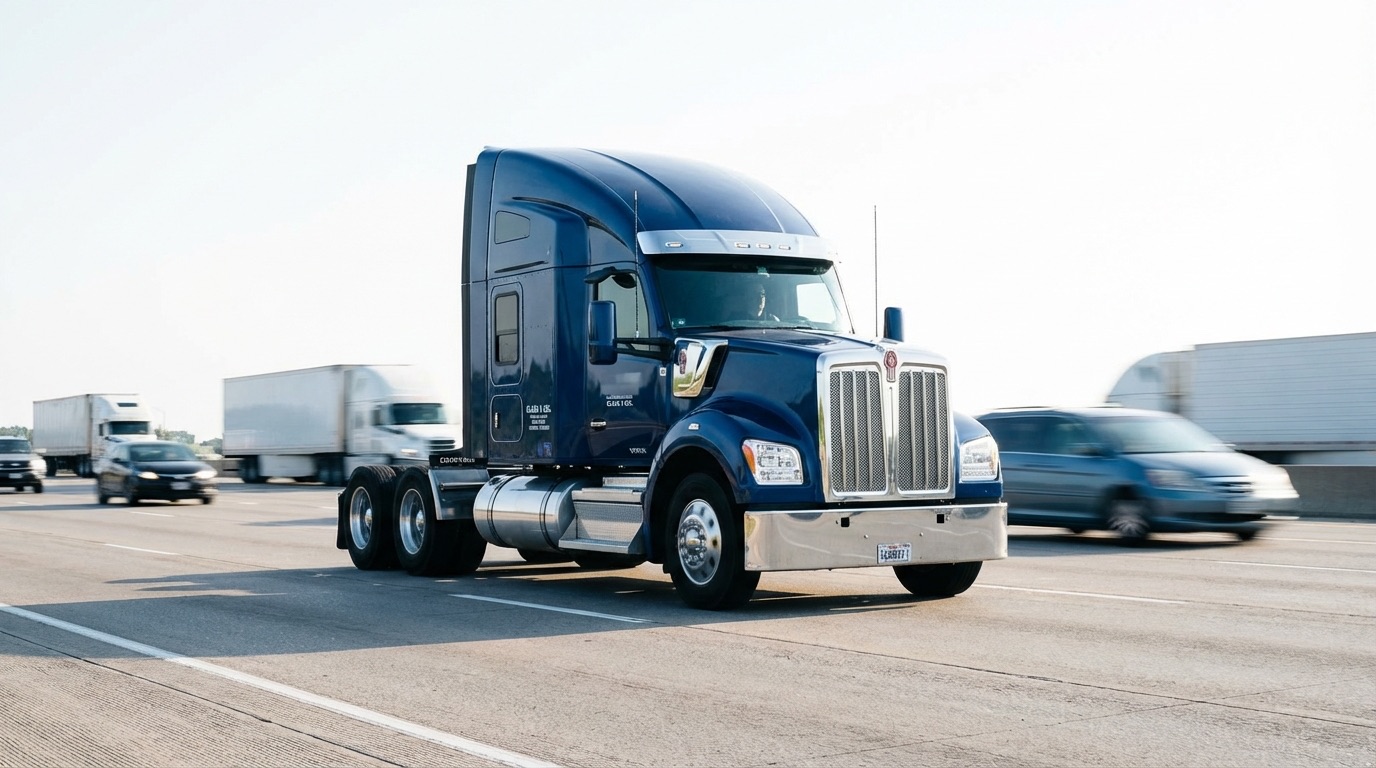
The 4 Knowledge Exams You Need to Pass
You take these at your state DMV to get your Commercial Learner's Permit (CLP). You need 80% or higher on each one.
General Knowledge
The foundation of your CDL. Covers vehicle inspection, basic control, shifting, hazard perception, night driving, emergencies, and cargo handling. You'll also need to know Hours of Service rules (including the Split Sleeper Berth provision) and why you disengage the Jake Brake on ice. 50 questions, 80% to pass, and the longest exam - give it the most study time.
Air Brakes
Every tractor-trailer runs on air brakes. You need to understand how the system builds pressure, dual air brakes, failure modes, and inspection procedures. One thing that trips people up: brake lag adds about 32 feet to your stopping distance at 55 mph because of the half-second air delay. Know snub braking vs. steady pressure, and never manually ratchet an automatic slack adjuster.
Combination Vehicles
The Class A exam. Coupling and uncoupling, rollover prevention, jackknife recovery, trailer skid control. You'll need to understand off-tracking vs. tail swing, and how sliding tandems shifts weight (roughly 250-500 lbs per hole). This is the test that separates A from B.
Pre-Trip Inspection
Class A pre-trip is longer than Class B because you're also inspecting the coupling system and trailer. Engine, cab, lights, walk-around, air brakes, fifth wheel, trailer body, doors - know them all.
15M+ students since 2010
50 states covered
Why Get a Class A CDL?
Highest earning ceiling
New drivers start around $50K. Specialized haulers and owner-operators clear $100K+. No other CDL class has this range.
Covers B and C too
One test series, and you can drive anything commercial. That's why most drivers skip straight to Class A.
Every trucking job is open
Long-haul, regional, local, flatbed, tanker, refrigerated. Class A is what the job postings ask for. And the federal Coercion Rule protects you from dispatchers pressuring you to violate safety rules.
Career has a next step
Add hazmat or tanker endorsements for higher pay. Go owner-operator. Move into training or logistics. It all starts with Class A.
What is a Class A CDL?
Class A is the CDL you need for tractor-trailers, semis, and any combination vehicle where the GCWR exceeds 26,001 lbs and the trailer weighs over 10,000 lbs. Basically, if you're pulling a heavy trailer, you need Class A.
It's also the only CDL that covers everything below it. Class A holders can drive Class B and Class C vehicles too, which is why most drivers skip straight to A even if they're not sure about long-haul yet. Full breakdown: CDL classes compared.
Pay range is wide. New drivers start around $50,000. With experience and the right endorsements (hazmat, tanker, oversized), $80,000-$100,000+ is realistic. Owner-operators can earn more than that.
Vehicles You Can Drive with Class A CDL
- Tractor-trailers (18-wheelers)
- Semi-trucks with trailers
- Tanker trucks
- Flatbed trailers
- Livestock carriers
- Refrigerated trailers (reefers)
- Car haulers
- Any combination where GCWR exceeds 26,001 lbs and towed vehicle exceeds 10,000 lbs
Class A vs Class B vs Class C - Quick Comparison
| CDL Class | Vehicle Type | Weight Requirements | Common Jobs |
|---|---|---|---|
| Class A | Combination vehicles (tractor + trailer) | GCWR 26,001+ lbs, towed vehicle 10,000+ lbs | Long-haul trucking, tankers, flatbeds |
| Class B | Single vehicles or small trailers | GVWR 26,001+ lbs, towed vehicle under 10,000 lbs | Buses, delivery trucks, dump trucks |
| Class C | Vehicles not meeting A or B criteria | Under 26,001 lbs with 16+ passengers or hazmat | Small buses, hazmat vans |
How to Get Your Class A CDL
1
Pass the 4 Written Tests
Study and pass 4 knowledge exams at your state DMV: General Knowledge, Air Brakes, Combination Vehicles, Pre-Trip Inspection. Score 80% or higher on each test. Select your state above to start practicing with our free tests.
2
Get Your CLP (Commercial Learner's Permit)
Once you pass the written tests, you get your CLP. It's a learner's permit for commercial vehicles - you can drive, but only with a licensed CDL holder in the passenger seat. You have to hold it for at least 14 days before you can take the skills test.
3
Complete ELDT Training
Federal law requires ELDT (Entry-Level Driver Training) for all first-time CDL applicants. You'll need two parts: theory training, which you can do online, and behind-the-wheel training with a registered provider. Our ELDT theory course is FMCSA-registered and 100% online - finish it whenever works for you.
4
Pass the Skills Test
Three parts here. Pre-Trip Inspection: you walk around the vehicle and explain what you're checking. Basic Control: backing up, parking, that kind of thing. Road Test: actual driving in traffic. Pro tip for backing maneuvers: use GOAL (Get Out And Look) - examiners actually want to see you do it. Clear all three and your CLP becomes a full Class A CDL. More on CDL requirements and classifications.
Class A CDL - Frequently Asked Questions
Figure 4-8 weeks total. That breaks down to 1-2 weeks studying for the written tests, 2-4 weeks of ELDT training, then the skills test. Some company-sponsored programs condense it into 3-4 weeks.
Private CDL schools run $3,000-$7,000. But many trucking companies will train you for free if you commit to driving for them for a year. Community colleges are another option at $1,500-$3,000. Our practice tests have a free tier you can start with right away.
Nationally, about 70-80% pass CDL written tests on the first try. Our students hit 99%, mostly because they've already seen every question type before walking into the DMV. Worth noting: once you're licensed, CSA violations from roadside inspections stay on your PSP record for 3 years, so building strong habits early matters.
Yes. No commercial driving experience required. You do need to be at least 18 (intrastate) or 21 (interstate), pass a DOT physical, and complete the written tests plus ELDT training.
No - you can go straight to Class A. And it's usually the better move, since Class A automatically covers Class B and C vehicles too.
CLP (Commercial Learner's Permit) comes first - you get it after passing the written tests. It lets you practice driving with a licensed CDL holder riding along. Once you finish ELDT training and pass the skills test, the CLP becomes a full CDL.
18 for driving within your state, 21 for crossing state lines. In practice, most trucking companies want you to be 21+ because of insurance and federal interstate rules.
New drivers usually start at $45,000-$55,000. With a few years of experience, $60,000-$80,000 is typical for long-haul. Specialized drivers (hazmat, oversized, tankers) and owner-operators can break $100,000. Geography and company matter a lot.
The main ones: H (Hazardous Materials), N (Tank Vehicles), T (Doubles/Triples), P (Passenger), and S (School Bus). Each one is a separate written test. HazMat also requires a TSA background check.
ELDT Theory Training
FMCSA-Registered ProviderOnce you pass the written exams and get your CLP, there's one more step before the skills test: ELDT (Entry-Level Driver Training). We offer the theory portion online - no classroom required.
100% Online Self-paced Instant Certificate
Learn About ELDT Training