Free Class B CDL Practice Tests
Class B is the fastest path to a commercial license - just 3 written tests stand between you and your CLP. Get ready with 2026 exam-like questions.
Three knowledge exams at the DMV: General Knowledge, Air Brakes, and Pre-Trip Inspection. No Combination Vehicles test (that's Class A only). Below are 968 practice questions covering all three, with scoring and explanations built in.
968 questions • 24 practice tests • Free to start
Start Your Class B CDL Practice
Practice tests for all 3 knowledge exams. Select your state to begin.
The 3 Knowledge Exams You Need to Pass
You take these at your state DMV to get your Commercial Learner's Permit (CLP). You need 80% or higher on each one.
General Knowledge
The big one - same test whether you're going for Class A or B. Vehicle inspection, basic control, hazard perception, night driving, emergencies, cargo handling. One thing that catches people off guard: empty trucks are harder to stop than loaded ones (brakes are designed for full weight). Know your cargo inspection schedule too - first check within 25 miles, then every 150 miles. 50 questions, 80% to pass.
Air Brakes
Most Class B vehicles run on air brakes, so skipping this gives you an L restriction that locks you out of most jobs. The test covers how the system builds pressure, dual air brakes, failure modes, and inspections. Key difference from Class A: single-vehicle leakage max is 2 psi per minute (vs 3 psi for combinations). 25 questions on the real exam.
Pre-Trip Inspection
On skills test day, you walk around the vehicle and call out what you're checking. No fifth wheel or coupling inspection like Class A, but if you're testing in a bus, add emergency exits, wheelchair lift, and stop arm to the list. Shorter than the Class A pre-trip, but you still need to know every component on your vehicle type.
15M+ students since 2010
50 states covered
Why Get a Class B CDL?
Local work, regular hours
Bus routes, construction sites, delivery runs. Most Class B jobs qualify for the 100 Air-Mile Radius exemption, which means no electronic logbook required. You sleep in your own bed.
3-6 weeks to get licensed
One fewer written test than Class A, less behind-the-wheel training. The fastest way into a commercial driving job.
Steady demand
Cities always need transit operators and delivery drivers. Construction doesn't stop either. These jobs don't disappear.
$40K-$60K+ a year
Union transit drivers in cities can do better. Garbage and ready-mix concrete drivers often clear $55K+. School bus drivers earn less but get summers off and solid benefits.
What is a Class B CDL?
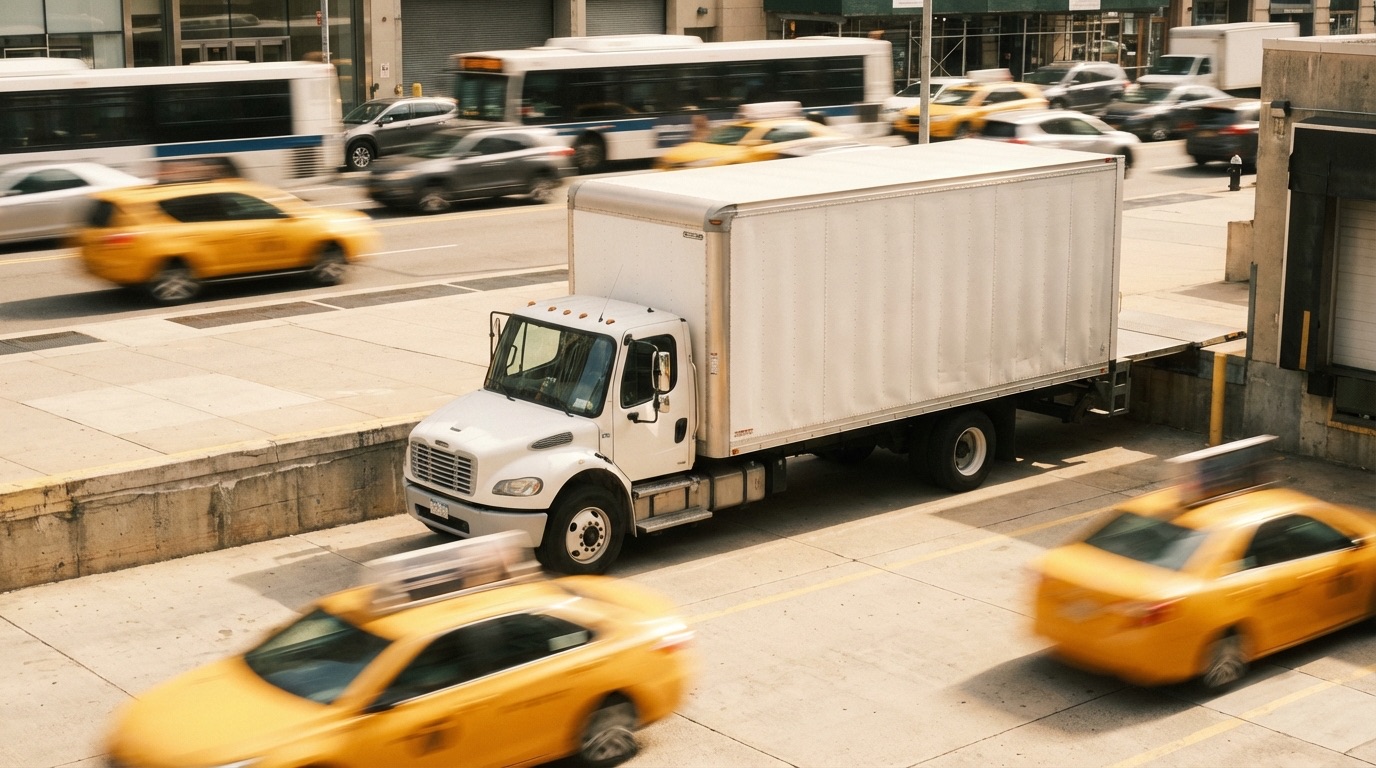
Think of Class B as the single-vehicle CDL. Buses, straight trucks, dump trucks, cement mixers - anything with a GVWR over 26,001 lbs that doesn't involve towing a heavy trailer. (You can tow up to 10,000 lbs, just nothing bigger.)
Compared to Class A, there's no Combination Vehicles test and the training period is shorter. Most Class B jobs are local, which means regular hours and sleeping at home. For a full side-by-side, see the CDL class comparison.
Salary range is $40,000-$60,000+ depending on the job. Union transit drivers in bigger cities do better. And if you decide you want more options later, you can always upgrade to Class A by passing one more written test.
Class B is a good fit if you want to:
- Drive buses, delivery trucks, or construction vehicles
- Work local routes and be home every night
- Get licensed quickly and start earning sooner
- Build CDL experience before moving up to Class A down the road
Vehicles You Can Drive with Class B CDL
- Straight trucks (box trucks)
- City buses and transit buses
- School buses (with S endorsement)
- Dump trucks
- Cement mixers
- Delivery trucks
- Garbage trucks
- Any single vehicle with GVWR of 26,001+ lbs, or towing a vehicle under 10,000 lbs
Class A vs Class B vs Class C - Quick Comparison
| CDL Class | Vehicle Type | Weight Requirements | Common Jobs |
|---|---|---|---|
| Class A | Combination vehicles (tractor + trailer) | GCWR 26,001+ lbs, towed vehicle 10,000+ lbs | Long-haul trucking, tankers, flatbeds |
| Class B | Single vehicles or small trailers | GVWR 26,001+ lbs, towed vehicle under 10,000 lbs | Buses, delivery trucks, dump trucks |
| Class C | Vehicles not meeting A or B criteria | Under 26,001 lbs with 16+ passengers or hazmat | Small buses, hazmat vans |
How to Get Your Class B CDL
1
Pass the 3 Written Tests
Study and pass 3 knowledge exams at your state DMV: General Knowledge, Air Brakes, Pre-Trip Inspection. Score 80% or higher on each test. Select your state above to start practicing with our free tests.
2
Get Your CLP (Commercial Learner's Permit)
Once you pass the written tests, you get your CLP. It's a learner's permit for commercial vehicles - you can drive, but only with a licensed CDL holder in the passenger seat. You have to hold it for at least 14 days before you can take the skills test.
3
Complete ELDT Training
Federal law requires ELDT (Entry-Level Driver Training) for all first-time CDL applicants. You'll need two parts: theory training, which you can do online, and behind-the-wheel training with a registered provider. Our ELDT theory course is FMCSA-registered and 100% online - finish it whenever works for you.
4
Pass the Skills Test
Three parts here. Pre-Trip Inspection: you walk around the vehicle and explain what you're checking. Basic Control: backing up, parking, that kind of thing. Road Test: actual driving in traffic. Pro tip for backing maneuvers: use GOAL (Get Out And Look) - examiners actually want to see you do it. Clear all three and your CLP becomes a full Class B CDL. More on CDL requirements and classifications.
Class B CDL - Frequently Asked Questions
Faster than Class A. Most people finish in 3-6 weeks: study for the written tests, do your ELDT training, then take the skills test. Some employer-sponsored programs are even quicker.
City bus driver, school bus driver (add the S endorsement), delivery driver at UPS or FedEx or Amazon, dump truck operator, cement mixer, garbage truck. Almost all of them are local routes with regular schedules.
Depends on what you want. Class A pays more and has more job options, but the training is longer. Class B is great if you want local work with regular hours. A lot of people start with B and upgrade to A after getting some experience.
Yes. You'll need to pass the Combination Vehicles written test and do additional ELDT training. Having Class B experience actually makes the transition smoother.
Technically not required, but skipping it gets you an L restriction that bars you from driving anything with air brakes. That rules out most buses, dump trucks, and large straight trucks - basically the majority of Class B jobs. The test is 25 questions. Just take it.
Generally $40,000-$60,000 a year. Transit bus drivers in cities with strong unions can earn more. School bus drivers usually make $30,000-$45,000, but the benefits and summers off balance it out for a lot of people.
P (Passenger) for vehicles with 16+ passengers, S (School Bus, which also requires P), N (Tank Vehicles - needed for cement mixers too), and H (Hazardous Materials). Each is a separate written test. The only endorsement you can't get with Class B is T (Doubles/Triples) - that's Class A only.
18 for intrastate, 21 for interstate. School bus drivers generally need to be 21+ regardless of route. Also: your BAC limit drops to 0.04% with a CDL (half the standard 0.08%), and a DUI conviction suspends your CDL for at least a year - even if you were driving your personal car.
ELDT Theory Training
FMCSA-Registered ProviderOnce you pass the written exams and get your CLP, there's one more step before the skills test: ELDT (Entry-Level Driver Training). We offer the theory portion online - no classroom required.
100% Online Self-paced Instant Certificate
Learn About ELDT Training