Free CDL School Bus Practice Tests
Yellow buses, kids, and a schedule that gives you summers off. You need Passenger (P) first, then pass the School Bus test.
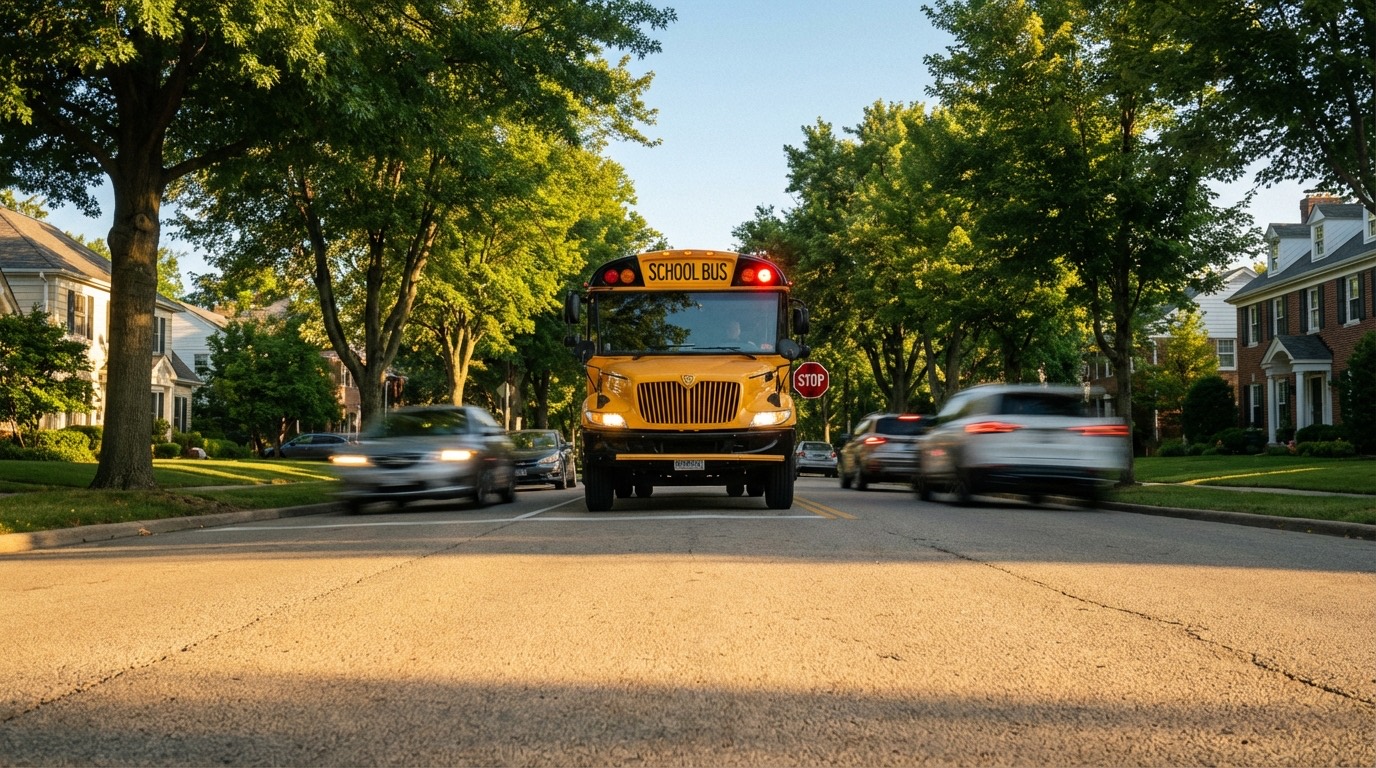
School bus drivers have rules nobody else does. Stop at every railroad crossing - even if the gates are up - open the door, listen. Know the 10-foot danger zone where kids are hardest to see. Master the stop arm and crossing gate. The test makes sure you understand why these rules exist: because kids don't always pay attention, and you have to.
170 questions • 7 practice tests • Free to start
Start Your School Bus Practice
Practice tests for the School Bus endorsement exam. Select your state to begin.
The 2 Knowledge Exams You Need to Pass
You take this at your state DMV. You need 80% or higher to pass. ELDT training is required before you can test.
Passenger Vehicles
First, you'll pass the Passenger (P) test. This covers general passenger safety, emergency exit operation, loading zones, and pre-trip inspection of passenger equipment. Required before you can test for School Bus.
School Bus
The School Bus test adds school-specific rules: danger zones (10 feet around the bus where children are most at risk), proper use of stop arm and crossing gate, loading/unloading procedures, railroad crossing requirements (stop, open window, look and listen), and emergency evacuation with children. You're responsible for these kids - the test reflects that.
15M+ students since 2010
50 states covered
Why Get the School Bus Endorsement?
Built-in summers off
School calendar = vacation. Use summers for family, travel, or a second gig.
Split shifts work for some
Morning route, home by 9am. Back at 2pm, done by 4pm. Midday is yours.
Districts often include benefits
Health insurance, retirement, paid training - even for part-time drivers in many districts.
You know the kids
Same route, same families. A lot of drivers say the relationships are the best part.
What is the School Bus Endorsement?
The School Bus endorsement (S) is specifically for yellow school buses carrying students to and from school. It builds on the Passenger (P) endorsement - you need P before you can get S.
Why the extra endorsement? School buses have unique rules. Stop arm and crossing gate operation, railroad crossing procedures (stop, open door and window, look and listen), danger zone awareness, and emergency evacuation with children. The test covers all of this.
Full ELDT is required - theory training plus behind-the-wheel training specific to school buses. You'll also need to pass a background check in most states (separate from any TSA check).
The schedule is different from other CDL jobs. Split shifts (morning and afternoon routes), summers off, school holidays off. Some drivers love it for the flexibility; others supplement with charter work or a second job.
Vehicles You Can Drive with School Bus
- Yellow school buses (Type A, B, C, D)
- Activity buses
- Head Start buses
- Any vehicle used to transport pre-primary, primary, or secondary school students to/from school or school activities
How to Get the School Bus Endorsement
1
Get CDL with Passenger (P) Endorsement First
School Bus (S) requires Passenger (P) as a prerequisite. If you don't have P yet, get that first. Most school bus drivers have Class B CDL with air brakes. See Passenger endorsement requirements.
2
Complete ELDT Training for School Bus
Full ELDT required - theory training plus behind-the-wheel training specific to school buses. This is in addition to ELDT for your CDL and Passenger endorsement. Our ELDT theory course is FMCSA-registered and 100% online.
3
Pass the School Bus Knowledge Test
20-25 questions at most DMVs, 80% to pass. Covers danger zones, stop arm and crossing gate operation, railroad crossing procedures, student loading/unloading, and emergency evacuation. Practice with our free tests above.
4
Pass Background Check + Skills Test
Most states require a background check for school bus drivers (separate from TSA). Then pass the skills test in an actual school bus. Once cleared, the S endorsement is added to your CDL.
School Bus Endorsement - Frequently Asked Questions
You need a CDL (Class A, B, or C depending on bus size) with both P (Passenger) and S (School Bus) endorsements. Most school buses require Class B with air brakes. You'll also need to pass a background check and meet your state's age requirements (usually 21+).
Four steps: (1) Get your CDL with Passenger (P) endorsement first. (2) Complete ELDT training (both theory and behind-the-wheel) for School Bus. (3) Pass the School Bus knowledge test at your DMV. (4) Pass the skills test in an actual school bus. Background check is also required in most states.
Yes. School Bus (S) is one of four that require full ELDT - theory training plus behind-the-wheel training. This is in addition to any ELDT you did for your initial CDL. The training covers school-bus-specific procedures.
P covers general passenger vehicle operation and safety. S builds on top of that with school-specific rules. You can't have S without P - it's a prerequisite. Plan to pass both knowledge tests, but you can take them the same day at most DMVs.
The danger zone is the 10-foot area around all sides of the bus where children are most at risk because the driver has limited visibility. Children should stay out of this zone unless loading/unloading, and the driver must account for children in this area before moving the bus. This is heavily tested.
National average is $35,000-$45,000 for full routes. Part-time drivers doing just morning and afternoon runs earn $15,000-$25,000. Charter and field trip drivers can supplement with additional work. Benefits (health insurance, retirement) add real value beyond the salary.
School buses must stop at all railroad crossings (15-50 feet from the nearest rail), even if no train is coming. Open the door and driver's window, look and listen both directions, then proceed only if the track is clear. Hazard lights on while stopped. This is a federal requirement.
Not with a school bus endorsement - that's specifically for school buses. Transporting students in personal vehicles falls under your state's volunteer driver rules, which usually require a regular driver's license plus background check and potentially additional insurance.
Most states require school bus drivers to be at least 21 years old, though some allow 18+ with restrictions. Beyond age, you'll need a clean driving record, pass a DOT physical, and clear a background check that screens for crimes involving children.
ELDT Theory Training
FMCSA-Registered ProviderSchool Bus endorsement requires both ELDT theory and behind-the-wheel training. We offer the theory portion online - no classroom required. You'll arrange behind-the-wheel training separately with a certified provider.
100% Online Self-paced Instant Certificate
Learn About ELDT Training