Free CDL Air Brakes Practice Test 2026
Air Brakes drivers earn up to $65,000/year - 40% more than standard CDL jobs. Our free practice tests help you pass the L endorsement exam on your first try.
25 questions, 80% to pass


Air Brakes Endorsement at a Glance
Key facts about the test and the process to get your L endorsement
25
Questions
80%
Passing Score
1 week
Time to Complete
Skills Test
Required
Free Air Brakes Practice Test
25 real exam-like questions with instant feedback. See how ready you are!
Question 1 of 25 🌙 Night owl 0 Correct 0 Incorrect
0 correct 0 incorrect
Not enough to pass
You need 0 more correct answers.
FMCSA-Approved ELDT Provider
Ready to pass for real?
Join 847,000+ drivers who got their Air Brakes endorsement with us.
Exam simulator mode
ELDT certificate included
Pass guarantee or money back
"The practice tests were almost identical to my real Air Brakes exam. Passed on my first try!"
How to Get Your Air Brakes Endorsement
Here's the step-by-step process to add the L endorsement to your CDL.
1
Understand the Restriction
If you don't pass the Air Brakes test, your CDL will have an "L" restriction - limiting you to vehicles WITHOUT air brakes. Most commercial trucks use air brakes, so this limits job options.
2
Study the CDL Manual
Focus on Section 5: Air Brakes. Learn about air brake system components, dual air systems, inspecting air brakes, and emergency procedures.
3
Pass the Written Test
Take the 25-question Air Brakes knowledge test at your DMV. You need 80% (20 correct) to pass.
4
Pass the Skills Test in an Air Brake Vehicle
You must demonstrate air brake operation during your CDL skills test. This includes the air brake check: pump the brake pedal until pressure drops and the knobs pop out. If you already passed your CDL skills test in a vehicle without air brakes, you'll need to take another skills test.
5
Get Your CDL Updated
Once you pass both tests, the "L" restriction is removed from your CDL. You're now authorized to drive vehicles with air brakes.
Official Resources
Government websites for Air Brakes endorsement requirements
Want More Practice?
Continue practicing with state-specific Air Brakes tests based on your CDL manual.
Alabama AL Alaska AK Arizona AZ Arkansas AR California CA Colorado CO Connecticut CT Delaware DE District of Columbia DC Florida FL Georgia GA Hawaii HI Idaho ID Illinois IL Indiana IN Iowa IA Kansas KS Kentucky KY Louisiana LA Maine ME Maryland MD Massachusetts MA Michigan MI Minnesota MN Mississippi MS Missouri MO Montana MT Nebraska NE Nevada NV New Hampshire NH New Jersey NJ New Mexico NM New York NY North Carolina NC North Dakota ND Ohio OH Oklahoma OK Oregon OR Pennsylvania PA Rhode Island RI South Carolina SC South Dakota SD Tennessee TN Texas TX Utah UT Vermont VT Virginia VA Washington WA West Virginia WV Wisconsin WI Wyoming WY
Frequently Asked Questions
What is the Air Brakes test?
The Air Brakes test has two parts: a written knowledge test about air brake systems, and a skills test where you demonstrate air brake operation in an actual vehicle. Passing both removes the "L" (air brake) restriction from your CDL.
What happens if I don't pass the Air Brakes test?
Your CDL will have an "L" restriction, meaning you can only drive commercial vehicles WITHOUT air brakes. Since most trucks and buses use air brakes, this severely limits your job options.
How do air brakes work?
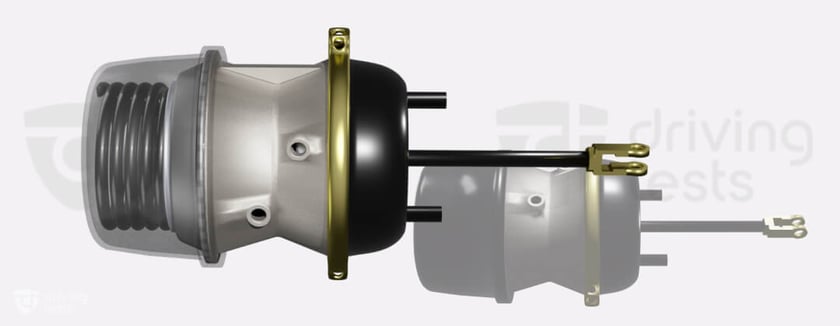
Air brakes use compressed air instead of hydraulic fluid to stop the vehicle. The air compressor pumps air into tanks, and when you press the brake pedal, air pressure pushes against the brake chambers to apply the brakes.
What is brake lag?
Brake lag is the time it takes for air to travel through the lines and apply the brakes after you press the pedal. At 55 mph, brake lag adds about 32 feet to your stopping distance.
What are spring brakes?
Spring brakes are emergency/parking brakes that use powerful springs. When air pressure drops (like from a leak), the springs push out and apply the brakes automatically. This is a safety feature.
How many questions are on the Air Brakes test?
25 questions, multiple choice. You need 20 right to pass (80%). The test covers air brake components, inspection, and emergency procedures.
What topics are covered?
The test covers: air brake system parts, dual air brake systems, inspecting air brakes, using air brakes, brake adjustment, low pressure warnings, and emergency stopping.
When should I drain the air tanks?
Drain air tanks at the end of each day of driving. Water and oil accumulate in the tanks and can freeze in cold weather, causing brake failure.
What pressure should the air compressor maintain?
The air compressor should maintain tank pressure between about 100-125 psi. The governor cuts in around 100 psi and cuts out around 125 psi.
Can I remove the L restriction later?
Yes! You'll need to pass the written Air Brakes knowledge test AND take a skills test in a vehicle equipped with air brakes. During the skills test, you'll demonstrate air brake checks including pumping the brake pedal until pressure drops and the emergency knobs pop out.
What Test-Takers Say
"My Air Brakes test was almost word for word from the study tests here. Took only 2 minutes to get 100%."
"Used this for my Texas Air Brakes test. Every single one of the 25 questions were on the practice test. Perfect score."
"Was at the DMV for 30 minutes. Got 25/25. Way better than paying $500 for a trucking school course."
Ready to Ace Your Air Brakes Test?
Free practice tests, no signup. Pick your state and crush it on your first try.
Select Your State