All your missed questions are saved
automatically for extra practice.



It's a practice test that's automatically made up of all your missed questions. Once you finish this test, you’ll be able to revisit your Challenge Bank™ to practice and sharpen your skills.
View All PlansAdding difficult questions to Challenge Bank™ is an exclusive Premium feature. Unlock access to 650+ exam-like questions, a Pass Guarantee, personalized study plans, and more.
View All PlansFree Maryland MVA Permit Practice Test 2026
| 90-100 | => | 9% |
| 80-89 | => | 13% |
| 70-79 | => | 20% |
| 60-69 | => | 22% |
| <60% | => | 35% |
To earn a learner’s permit in Maryland, you must pass a vision screening and the official Maryland knowledge test. It consists of 25 multiple-choice questions covering laws, regulations, and road signs, and you must answer at least 22 of 25 questions correctly to pass (88%). Unlike some states, there are no online options – you must take it in person.
Our free online Maryland permit practice test is current for July 2026 and provides questions and answers based on the Maryland MVA 2026 Driver Handbook. Our tests provide instant feedback on each question and mimic the official Maryland written test.
When ready, go to the Maryland MVA with proof of identity and age (birth certificate or passport), proof of Maryland residency (two documents required, such as utility bills or bank statements), proof of your Social Security number, and parental consent form if under 18. Submit the documents, pay the fee, and take the knowledge test.
If you fail the test, you must wait one business day and pay the retake fee before taking it again.
Maryland operates a graduated licensing program (GDL) that applies to drivers under 25 (the “Rookie Driver” program). Even if you’re between 18 and 24 and just starting to drive, you still need to go through the GDL stages: Learner’s Permit, Provisional License, and Full Driver’s License. The learner’s permit requires you to practice driving with a qualified supervising driver. The provisional license stage allows for unsupervised driving but has some restrictions. Once you’ve held your provisional license for 18 months without any violations or preventable crashes, you move to the full driver’s license stage.
Individuals 25 and older follow a slightly modified process, requiring fewer practice hours before a driving test. In Maryland, what most people call the “DMV” is officially the MVA (Motor Vehicle Administration).
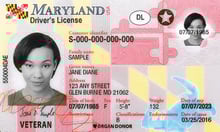



Maryland permit test: quick facts
What to expect at the MVA
Where Maryland test-takers struggle most
Based on 5,434 Maryland learners who practiced on our site in the last 30 days. 40% pass our practice tests, with an average first-try score of 67%.
Maryland law requires all vehicles to have functioning headlights, taillights, brake lights, and turn signals. Equipment that is broken or improperly adjusted is an immediate road test failure and a citable offense on public roads.
A yellow light means stop if you can do so safely, not speed up to clear the intersection. Maryland treats running a red light the same whether you entered on yellow or red - the standard is whether stopping was possible.
When a vehicle loses its brakes, drivers should downshift progressively, use the parking brake gradually, and look for an escape route such as a runaway truck ramp or open field. Steering into a guardrail or curb is a last resort to slow the vehicle.
Maryland's BAC limit is 0.08% for drivers 21 and older. Drivers under 21 are subject to zero tolerance - any detectable alcohol triggers license suspension regardless of impairment level.
Cyclists have the same rights and responsibilities as motor vehicle operators on Maryland roads. Drivers must leave at least 3 feet of clearance when passing a bicycle and may not cut back in front of the cyclist immediately after passing.
Data updated daily from our practice test results
First-try score distribution
How Maryland learners score on their first practice test attempt
Maryland-specific rules you must know
Rules that are unique to Maryland or differ from most other states
Maryland expanded Noah's Law in October 2024 to require ignition interlock installation for all DUI convictions, including first-time offenses. The previous law had a loophole that allowed first-time offenders to avoid interlock requirements. That loophole is now closed.
Maryland applies GDL-style restrictions to all new drivers under 25, not just teenagers. The Rookie Driver Program covers nighttime driving limits, passenger restrictions, and zero-tolerance alcohol rules for any driver who has not yet held a full license - regardless of whether they are 17 or 24.
Under Jake's Law, causing serious injury or death while driving distracted is a separate criminal offense in Maryland. Penalties include fines up to $5,000 and up to 1 year of imprisonment. This goes beyond the standard traffic citation system.
Maryland requires a vision test at license renewal beginning at age 40 - the youngest threshold of any U.S. state. Most states do not begin mandatory vision checks until age 50 or later. Drivers who fail the vision test must provide a physician's clearance before renewing.

Reviewed for legal and handbook accuracy
M.S. (MIT, Columbia), Chief Educational Researcher. ACES member (Society for Editing). Verifies all 50 state tests against official handbooks weekly.

How to use this practice test
- Start here. One of 4 free online Maryland tests. ~6 min. Read explanations as you go.
- Cover more ground. All tests have different questions - no repeats.
- Finish strong. Try the Exam Simulator for a full-length run.
Why this works
- Exam-like questions from the current handbook + questions most people get wrong. Explanations cite the manual.
- AI Assistant explains like a friend.
- Performance Insights shows where you need work.
- Challenge Bank™ saves your mistakes for targeted practice.
- Proven Progress Students improve from 67% → 72% after just 3 tests.
Sample Maryland permit test questions
7 questions written and verified by our content team against the current Maryland Driver Handbook
- Question 1 of 7
What does Maryland's Move Over Law require you to do when approaching a vehicle stopped on a highway with its lights flashing?
Show answer & explanation
Correct answer: B - Move into a lane not immediately adjacent to the stopped vehicle, or slow to a safe speed if you cannot move over
The Move Over Law applies to any vehicle stopped, standing, or parked on a highway with its lights flashing - not just emergency vehicles. If moving over isn't safe or feasible, you must slow to a reasonable and prudent speed. A basic violation carries a $110 fine and one point. If someone is killed or seriously injured, the fine jumps to $750 and three points.
Source: MD Driver's Manual, Section 8D - Question 2 of 7
During the first 5 months (151 days) of holding a provisional license in Maryland, which passengers under 18 are you allowed to carry without a supervising driver?
Show answer & explanation
Correct answer: B - Only direct family members such as siblings, stepchildren, or a relative living at the same address
For the first 151 days of the provisional period, passengers under 18 are off-limits unless a qualified supervising driver is present - or the passengers are direct family members. That includes a spouse, son, daughter, stepchild, sibling, stepsibling, or a relative who lives at the same address.
Source: MD Driver's Manual, Section 9A - Passenger Restriction - Question 3 of 7
In which of these situations does Maryland law require you to turn on your headlights?
Show answer & explanation
Correct answer: C - Whenever your windshield wipers are in use due to inclement weather
Unlike many other states, Maryland does not have a time-dependent rule (such as "between sunset and sunrise") for when your headlights must be on. Instead, if your wipers are on because of weather, your headlights must also be on. The law also requires headlights anytime you can't clearly see at least 1,000 feet ahead. Foggy conditions, stormy weather, and nighttime driving all qualify.
Source: MD Driver's Manual, Section 5A - Headlight Use - Question 4 of 7
How many supervised practice hours must a Maryland learner's permit holder under age 25 complete before qualifying for a provisional license?
Show answer & explanation
Correct answer: B - 60 hours, with 10 during the period from 30 minutes before sunset to 30 minutes after sunrise
Applicants younger than 25 need a full 60 hours of supervised practice. At least 10 of those hours must happen during the low-light window - starting 30 minutes before sunset and ending 30 minutes after sunrise. All hours go into a Practice and Skills Log that the applicant must maintain and submit. Applicants 25 and older only need 14 hours.
Source: MD Driver's Manual, Section 2B - Learner's Instructional Permit - Question 5 of 7
What does Maryland law say about a driver under 18 using a hands-free phone while driving?
Show answer & explanation
Correct answer: B - Drivers under 18 may not use any wireless communication device, including hands-free, except for a 911 emergency call
Adults can legally use hands-free devices behind the wheel, but drivers under 18 get no such exception. They are banned from using any wireless communication device while driving - hands-free included. The only carve-out is a 911 emergency call. This applies to both learner's permit and provisional license holders.
Source: MD Driver's Manual, Section 6C - Cell Phones; Section 9A - Wireless Device Restriction - Question 6 of 7
When passing a bicyclist on a Maryland road, how much clearance must you give?
Show answer & explanation
Correct answer: B - At least 3 feet
Wait until oncoming traffic is clear, then allow at least 3 feet of clearance between your car and the bicyclist. The same 3-foot rule applies whether the cyclist is in a bike lane, on the shoulder, or sharing your travel lane. After passing, check your mirror to confirm you've cleared the bicycle completely before moving back to the right.
Source: MD Driver's Manual, Section 7F - Pass with Care - Question 7 of 7
Under Maryland law, which children must ride in an appropriate child safety seat?
Show answer & explanation
Correct answer: C - All children under age 8, unless the child is 4'9" or taller
Every child under 8 must be in an appropriate child safety seat, unless they are already 4'9" or taller. Children younger than 2 must ride in a rear-facing seat that meets federal guidelines until they hit the height or weight limit set by the manufacturer. The KISS program (Kids In Safety Seats) can help families who can't afford a seat.
Source: MD Driver's Manual, Section 10G - Child Safety Seats
Verified by Steven Litvintchouk, M.S. (MIT), Chief Educational Researcher, on .
Real Maryland drivers who passed first try
Verified student reviews • Shared with permission
Are you in another state?
- Connecticut
- Delaware
- New Jersey
- New York
- North Carolina
- Ohio
- Pennsylvania
- Rhode Island
- Virginia
- West Virginia
We know what it takes to pass. And we’ve got the proof.
Driver’s Ed is - nobody wants to set foot inside the MVA. That’s why millions of learners trust us for simple, visual, effective prep.
An official & trusted partner in driver education
We are an officially recognized FMCSA Entry-Level Driver Training provider and a proud partner to over 2,500 libraries. We work with safety organizations like GHSA and the National Safety Council to help create safer roads for everyone.



A smarter way to study for the permit test
Challenge Bank™
Our trademarked system automatically saves questions you miss, creating personalized tests that target your weak spots until you’ve mastered the material.
AI-powered feedback
Get smarter as you study. Our new AI-powered feedback provides detailed, question-level insights to help you understand the why behind each answer.
Interactive handbook
Go beyond the boring black-and-white manual. Our interactive handbook lets you read, listen with an MP3 audio version, or even chat with it to find the information you need, faster.
We build our practice questions from the current 2026 MD Driver Handbook and refine them using patterns recent test‑takers report.
Driver handbook • Knowledge‑test/permit overview • Fees & ID requirements • Office/appointment info
We mirror recurring themes (e.g., right‑of‑way traps, sign look‑alikes) and use similar distractors and wording styles.
We don’t collect or publish actual test items and we’re not affiliated with MVA.
- 0 Incorrect (2 allowed to pass)
- 0 Correct
Are you sure you want to restart your test?
Your test progress will be lost.