All your missed questions are saved
automatically for extra practice.


It's a practice test that's automatically made up of all your missed questions. Once you finish this test, you’ll be able to revisit your Challenge Bank™ to practice and sharpen your skills.
View All PlansAdding difficult questions to Challenge Bank™ is an exclusive Premium feature. Unlock access to 650+ exam-like questions, a Pass Guarantee, personalized study plans, and more.
View All PlansFree Pennsylvania DOT PA Permit Test Practice 2026
| 90-100 | => | 7% |
| 80-89 | => | 12% |
| 70-79 | => | 20% |
| 60-69 | => | 23% |
| <60% | => | 38% |
To get your Pennsylvania DOT Learner’s Permit, you must be at least 16 years old and pass a vision screening and the written knowledge test. The permit test consists of 18 multiple-choice questions covering material outlined in the state’s Pennsylvania DOT 2026 Driver’s Manual. To pass, you must score at least 83% (15 out of 18 questions).
This free online Pennsylvania DOT permit practice test – often called the written or knowledge test – is current for July 2026 and mimics real exam conditions based on the state manual. Immediate feedback is provided on all questions to speed learning. You’ll also learn about Pennsylvania’s unique driving laws, like the 4-second rule and PA’s tri-tiered intoxication system under statutes 75 Pa.C.S. § 3802.
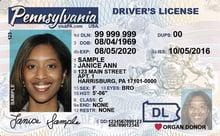
Once you’re ready to apply for the permit, go to the DOT with proof of identity (birth certificate, passport), Social Security card, and proof of residence (utility bill, bank statement). If you’re under 18, you will need the Parent or Guardian Consent Form (Form DL-180TD), signed in person. Submit the documents, pass a vision screening, pay the fee, and pass the official written test.
If you fail, you must wait until the next business day to retest.
Pennsylvania’s Graduated Driver Licensing (GDL) program applies to drivers under 18. At age 16, you can apply for a learner’s permit, which allows driving under the supervision of a licensed driver who is 21 years or older. You must log at least 65 hours of supervised practice (including ten at night and five in bad weather) over a six-month period. After six months, you can pass a road skills test for a Junior License. This license allows only one non-family passenger under 18, and unsupervised driving is only allowed between 5 AM and 11 PM (with exceptions for work, volunteer service, or if accompanied by a family member who is 18 or older). To get an unrestricted license, you must keep a clean driving record for one year, complete an approved driver’s education course, or turn 18.
If you’re 18 or older, most GDL requirements do not apply. You must still obtain a learner’s permit, although there’s no specific requirement for practice hours. Once you’re confident in your driving skills, you can schedule a road test and obtain your unrestricted driver’s license.



Pennsylvania permit test: quick facts
What to expect at the DOT
Where Pennsylvania test-takers struggle most
Based on 6,748 Pennsylvania learners who practiced on our site in the last 30 days. 41% pass our practice tests, with an average first-try score of 65%.
Pennsylvania requires headlights on from sunset to sunrise, during any precipitation, and whenever visibility is less than 1,000 feet. Vehicles must pass a state safety inspection annually, covering brakes, lights, tires, steering, and other components. Turn signals must be activated at least 100 feet before turning or changing lanes.
You must stop between 15 and 50 feet from a railroad crossing when signals are flashing or gates are lowering. Never attempt to cross the tracks until the gates have fully risen and the lights have stopped flashing. If a train is approaching, the gate or signal may activate before the train is visible, so stopping immediately is required.
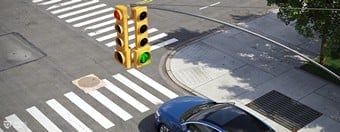
At a steady red light, a right turn is permitted after a complete stop only if no sign prohibits it and you yield to all cross traffic and pedestrians. A flashing red light requires a full stop and then yielding before proceeding. A green arrow means the indicated turn is protected and oncoming traffic is stopped by a red signal.
Pennsylvania law requires headlights during active precipitation - this is stricter than the standard "visibility under 1,000 feet" rule alone. On slippery roads, increase your following distance to at least 4-6 seconds and reduce speed before curves, not during them. Four-wheel drive does not improve braking distance on ice - it only helps with acceleration traction.
In Pennsylvania, you may not park within 15 feet of a fire hydrant, within 20 feet of a crosswalk at an intersection, or within 30 feet of a stop sign or traffic signal. Parking on the left side of a one-way street is permitted unless signs prohibit it. When parking downhill on a road without a curb, turn your wheels to the right so the vehicle would roll off the road rather than into traffic.
Data updated daily from our practice test results
First-try score distribution
How Pennsylvania learners score on their first practice test attempt
Pennsylvania-specific rules you must know
Rules that are unique to Pennsylvania or differ from most other states
Pennsylvania's 65-hour supervised driving log - already one of the highest hour requirements in the country - includes a specific requirement for at least 5 hours driven in adverse weather conditions. Rain, snow, fog, or other poor-visibility situations must make up part of the documented practice time. No other state has this specific weather-hour requirement written into the permit log.
Pennsylvania's Move Over Law requires drivers approaching stopped emergency vehicles with lights active to move to an adjacent lane if safe to do so. If a lane change is not possible, drivers must slow to a speed at least 20 mph below the posted speed limit. This rule applies to police, fire, ambulance, tow trucks, and highway maintenance vehicles.
Pennsylvania healthcare providers are legally required to report patients with certain medical conditions that may affect driving ability to PennDOT within 10 days of diagnosis. Failure to report is a criminal offense. This means PennDOT can initiate a medical review of your driving privileges based on a doctor's report, without any traffic stop or violation triggering the review.
Pennsylvania drivers under 18 who receive their first at-fault accident or moving violation must complete the Steer Clear driver improvement program before their driving privileges are fully restored. The program is a self-paced defensive driving course. A second violation within the first year results in a 90-day suspension of the junior driver's license.

Reviewed for legal and handbook accuracy
M.S. (MIT, Columbia), Chief Educational Researcher. ACES member (Society for Editing). Verifies all 50 state tests against official handbooks weekly.

How to use this practice test
- Start here. One of 4 free online Pennsylvania tests. ~6 min. Read explanations as you go.
- Cover more ground. All tests have different questions - no repeats.
- Finish strong. Try the Exam Simulator for a full-length run.
Why this works
- Exam-like questions from the current handbook + questions most people get wrong. Explanations cite the manual.
- AI Assistant explains like a friend.
- Performance Insights shows where you need work.
- Challenge Bank™ saves your mistakes for targeted practice.
- Proven Progress Students improve from 65% → 72% after just 3 tests.
Sample Pennsylvania permit test questions
7 questions written and verified by our content team against the current Pennsylvania Driver Handbook
- Question 1 of 7
Under Pennsylvania law, how many hours of behind-the-wheel skill-building must drivers under 18 complete before taking the Road Test?
Show answer & explanation
Correct answer: C - 65 hours
Drivers under 18 are required to complete at least 65 hours of behind-the-wheel practice, including no less than 10 hours of nighttime driving and 5 hours of bad weather driving (Chapter 1, "Junior Learner's Permit Information").
- Question 2 of 7
A junior driver's license in Pennsylvania restricts driving between what hours unless a parent, guardian, or other responsible adult is present?
Show answer & explanation
Correct answer: B - 11 p.m. and 5 a.m.
The curfew for junior driver's license holders runs from 11 p.m. to 5 a.m. unless a parent, guardian, person in loco parentis, or spouse age 18+ is in the vehicle. There are exceptions, however. If you have a junior license, you may drive between 11 p.m. and 5 a.m. if you are employed, involved in public or charitable service, or a member of a volunteer fire company during those hours (Chapter 1, "Junior Driver's License Information").
- Question 3 of 7
When a school bus stops with its red lights flashing and stop arm extended, you must stop at least how many feet from the bus?
Show answer & explanation
Correct answer: D - 10 feet
You must stop at least 10 feet away from a school bus that has its red lights flashing and stop arm extended, whether you are behind it or coming toward it on the same roadway (Chapter 3, "School Buses"). The only exception is if you are on the opposite side of a divided highway separated by a physical barrier or median - in that case, you may reduce your speed and continue with caution. Failing to stop carries a 60-day license suspension, five points on your driving record, and a fine.
- Question 4 of 7
How many points does PennDOT require on a driver's record before it begins taking corrective action?
Show answer & explanation
Correct answer: B - 6 or more points
Corrective action starts when a driver accumulates 6 or more points on their record. The first time this happens, the driver receives a written notice to take a special point examination. A second accumulation of 6 points triggers a Departmental hearing (Chapter 4, "The Pennsylvania Point System").
- Question 5 of 7
What is the legal blood alcohol content (BAC) limit for drivers under 21 in Pennsylvania?
Show answer & explanation
Correct answer: C - 0.02
The Zero Tolerance law sets the BAC limit at .02 for anyone under 21, well below the standard .08 for drivers of legal drinking age (Chapter 4, "Zero Tolerance Law"). A first DUI conviction for an under-21 driver carries 2 days to 6 months in jail, a full-year license suspension, and fines up to $5,000.
- Question 6 of 7
State law requires you to turn on your headlights whenever your windshield wipers are in continuous or intermittent use. Excluding fees and other associated costs, what is the base fine for violating this law?
Show answer & explanation
Correct answer: A - $25
The headlight/windshield wiper law took effect on January 28, 2007. It mandates headlights anytime wipers are running - daytime running lights alone are not enough. Tail lights must also be illuminated when your wipers are on. The base fine for violating this law is $25. However, when fees and other associated costs are included, the total monetary penalty can be much higher. (Chapter 3, "Headlight/Windshield Wiper Law").
- Question 7 of 7
When driving at 35 mph or more in Pennsylvania, how far in advance must you signal before turning?
Show answer & explanation
Correct answer: C - 300 feet
You must signal at least 100 feet before turning if driving under 35 mph, and at least 300 feet if driving 35 mph or more (Chapter 3, "Communicating Your Intentions to Other Drivers").
Verified by Steven Litvintchouk, M.S. (MIT), Chief Educational Researcher, on .
Real Pennsylvania drivers who passed first try
Verified student reviews • Shared with permission
Are you in another state?
We know what it takes to pass. And we’ve got the proof.
Driver’s Ed is - nobody wants to set foot inside the DOT. That’s why millions of learners trust us for simple, visual, effective prep.
An official & trusted partner in driver education
We are an officially recognized FMCSA Entry-Level Driver Training provider and a proud partner to over 2,500 libraries. We work with safety organizations like GHSA and the National Safety Council to help create safer roads for everyone.



A smarter way to study for the permit test
Challenge Bank™
Our trademarked system automatically saves questions you miss, creating personalized tests that target your weak spots until you’ve mastered the material.
AI-powered feedback
Get smarter as you study. Our new AI-powered feedback provides detailed, question-level insights to help you understand the why behind each answer.
Interactive handbook
Go beyond the boring black-and-white manual. Our interactive handbook lets you read, listen with an MP3 audio version, or even chat with it to find the information you need, faster.
We build our practice questions from the current 2026 PA Driver Handbook and refine them using patterns recent test‑takers report.
Driver handbook • Knowledge‑test/permit overview • Fees & ID requirements • Office/appointment info
We mirror recurring themes (e.g., right‑of‑way traps, sign look‑alikes) and use similar distractors and wording styles.
We don’t collect or publish actual test items and we’re not affiliated with DOT.
- 0 Incorrect (3 allowed to pass)
- 0 Correct
Are you sure you want to restart your test?
Your test progress will be lost.