

All your missed questions are saved
automatically for extra practice.




It's a practice test that's automatically made up of all your missed questions. Once you finish this test, you’ll be able to revisit your Challenge Bank™ to practice and sharpen your skills.
View All PlansAdding difficult questions to Challenge Bank™ is an exclusive Premium feature. Unlock access to 650+ exam-like questions, a Pass Guarantee, personalized study plans, and more.
View All PlansFree Illinois DMV Permit Practice Test 2026
| 90-100 | => | 16% |
| 80-89 | => | 27% |
| 70-79 | => | 27% |
| 60-69 | => | 18% |
| <60% | => | 12% |
The Illinois permit test has 35 questions split into two sections: 20 on traffic laws (multiple-choice and true/false) and 15 on traffic sign identification by shape, color, and symbol. To pass, you must answer at least 28 correctly (80%). The test is based on the Illinois Rules of the Road handbook.
This Illinois DMV permit practice test is current for June 2026, featuring questions directly from the official 2026 IL Driver Handbook. In Illinois, what most people call the “DMV” is officially the SOS (Secretary of State).
To apply, bring one document from each of four groups: proof of date of birth (birth certificate, passport), proof of Social Security number (SS card, pay stub), proof of residency (utility bill, bank statement), and proof of written signature. The test must be taken in person at a Secretary of State Driver Services facility – there is no online option.
You can retake the test up to 3 times within one year from the date your application fee was paid. After 3 failures, you must reapply and pay the fee again. Anyone caught cheating fails and is banned from retaking for 30 days.
Illinois’ Graduated Driver’s License (GDL) program has three phases. At age 15, teens enrolled in an approved driver education course can get an instruction permit. The permit must be held for at least 9 months, and 50 hours of supervised driving (including 10 at night) are required. Nighttime curfews apply: 10 PM-6 AM on school nights, 11 PM-6 AM on weekends. At age 16, with driver ed complete and a clean record, you can get your initial license – but passenger limits (1 under 20, siblings exempt) and the nighttime curfew continue until age 18. No cell phone use (including hands-free) for drivers under 19.
Ages 18-20 applying for a first license must complete a 6-hour adult driver education course if they never took driver ed in high school. They still need to pass vision, written, and road tests at the SOS facility. At age 17 years and 3 months, you can apply for a permit without driver education.

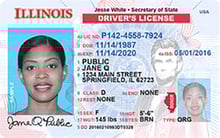



Illinois permit test: quick facts
What to expect at the DMV
Where Illinois test-takers struggle most
Based on 18,667 Illinois learners who practiced on our site in the last 30 days. 36% pass our practice tests, with an average first-try score of 74%.
Illinois's Scott's Law requires drivers to move over or slow to a safe speed when passing emergency or maintenance vehicles stopped on the side of the road. Violations can result in fines up to $10,000 - one of the highest move-over penalties in the country.
Illinois winters mean drivers must understand rules around traction, following distance, and visibility. The state handbook emphasizes increasing your following distance well beyond the standard 3 seconds whenever road surfaces are wet, snowy, or icy.
Warning signs test-takers miss are often shape-and-meaning combinations - the specific shape carries its own meaning independent of any text. Pennant-shaped signs, for instance, indicate a No Passing Zone and appear only on the left side of the road.
Illinois requires drivers to signal at least 100 feet before a turn, and this is commonly tested alongside regulatory sign content. Signs that establish speed limits in school or construction zones carry automatic fine-doubling provisions that many test-takers overlook.
Passing on the right is only legal in Illinois under specific conditions - when the vehicle ahead is turning left or when road width permits two lanes of traffic in the same direction. Passing on a two-lane road over a solid yellow center line is always prohibited.
Data updated daily from our practice test results
First-try score distribution
How Illinois learners score on their first practice test attempt
Illinois-specific rules you must know
Rules that are unique to Illinois or differ from most other states
Scott's Law requires drivers approaching a stationary emergency, maintenance, or construction vehicle with flashing lights to either move to an adjacent lane or reduce speed to a safe level. Fines can reach $10,000 for violations, and repeat offenses can result in license suspension.
Illinois enforces a 0.00% BAC standard for any driver under 21 - any detectable trace of alcohol is a violation. This is stricter than the standard 0.02% threshold used by most other states for underage drivers.
Refusing a chemical test (breath, blood, or urine) results in a 12-month statutory summary suspension for a first offense. Accepting the test and failing (BAC at or above 0.08%) results in a 6-month suspension - so refusal carries the longer penalty. 9-month permit holding period Illinois requires learner's permit holders to hold their permit for at least 9 months before qualifying for a full license. This is longer than the typical 6-month requirement used by most states.

Reviewed for legal and handbook accuracy
M.S. (MIT, Columbia), Chief Educational Researcher. ACES member (Society for Editing). Verifies all 50 state tests against official handbooks weekly.

How to use this practice test
- Start here. One of 4 free online Illinois tests. ~6 min. Read explanations as you go.
- Cover more ground. All tests have different questions - no repeats.
- Finish strong. Try the Exam Simulator for a full-length run.
Why this works
- Exam-like questions from the current handbook + questions most people get wrong. Explanations cite the manual.
- AI Assistant explains like a friend.
- Performance Insights shows where you need work.
- Challenge Bank™ saves your mistakes for targeted practice.
Sample Illinois permit test questions
6 questions written and verified by our content team against the current Illinois Driver Handbook
- Question 1 of 6
Under Scott's Law, what must you do when approaching a stationary emergency vehicle displaying flashing lights on a highway?
Show answer & explanation
Correct answer: B - Change to a lane away from the emergency vehicle when possible, and proceed with caution
Scott's Law requires motorists to yield, change to a lane away from emergency workers when possible, and proceed with caution. If a lane change is not safe, you must slow down or stop as appropriate for the situation, and move away so there is an empty traffic lane separating you and the emergency vehicle if possible and safe to do so.
Source: IL Rules of the Road, Chapter 4 - Emergency/Maintenance Vehicles, p.25 - Question 2 of 6
During the Initial Licensing Phase for drivers ages 16-17, how many passengers under age 20 are allowed in the vehicle for the first 12 months?
Show answer & explanation
Correct answer: B - One passenger under 20
For the first 12 months of the Initial Licensing Phase (or until the driver turns 18, whichever comes first), the number of passengers is limited to one person under age 20. Siblings, stepsiblings, and children or stepchildren of the driver are exempt from this count. After that period, the limit expands to one in the front seat and the number of safety belts in the back.
Source: IL Rules of the Road, Chapter 3 - Graduated Driver Licensing Program, p.18 - Question 3 of 6
Which statement about Illinois' distracted driving law is correct?
Show answer & explanation
Correct answer: B - Drivers age 19 and older may use hands-free devices while driving
Hands-free devices and Bluetooth are only permitted for drivers 19 and older. Holding the phone while using the speaker does NOT qualify as hands-free under state law. For drivers under 19, any wireless or cellphone use while driving is prohibited - the only exception is calling 911 or contacting a law enforcement agency, health care provider, or emergency services agency.
Source: IL Rules of the Road, Chapter 4 - Distracted Driving, p.22 - Question 4 of 6
What is the speed limit when driving through an alley in Illinois?
Show answer & explanation
Correct answer: B - 15 mph
The maximum speed in any alley is 15 mph. Other Illinois default speed limits: 20 mph in school zones, 30 mph in city/town areas, 55 mph on other highways and rural areas, 65 mph on four-lane highways, and 70 mph on interstates and tollways.
Source: IL Rules of the Road, Chapter 4 - Speed Limits, p.24 - Question 5 of 6
Until what age must a child ride in a rear-facing child restraint system in Illinois?
Show answer & explanation
Correct answer: B - Age 2, unless they weigh more than 40 pounds or are taller than 40 inches
A law effective January 1, 2019, requires children to be properly secured in a rear-facing restraint until age 2 - unless the child weighs more than 40 pounds or is more than 40 inches tall. All children under age 8 must also be in an appropriate child safety restraint system, which includes booster seats used with a lap/shoulder belt.
Source: IL Rules of the Road, Chapter 4 - Child Passenger Protection Act, p.23-24 - Question 6 of 6
How many license plates must be displayed on a passenger vehicle registered in Illinois?
Show answer & explanation
Correct answer: B - Two plates - one on the front and one on the rear
State law requires all passenger vehicles, trucks, and vans to display two plates - one on the front and one on the rear. License plate frames must not cover any information on the plates, and plate covers are not allowed. Motorcycles, mopeds, trailers, and semitrailers only need one plate on the rear.
Source: IL Rules of the Road, Chapter 13 - License Plate Requirements, p.95
Verified by Steven Litvintchouk, M.S. (MIT), Chief Educational Researcher, on .
Real Illinois drivers who passed first try
Verified student reviews • Shared with permission
Are you in another state?
We know what it takes to pass. And we’ve got the proof.
Driver’s Ed is - nobody wants to set foot inside the DMV. That’s why millions of learners trust us for simple, visual, effective prep.
An official & trusted partner in driver education
We are an officially recognized FMCSA Entry-Level Driver Training provider and a proud partner to over 2,500 libraries. We work with safety organizations like GHSA and the National Safety Council to help create safer roads for everyone.



A smarter way to study for the permit test
Challenge Bank™
Our trademarked system automatically saves questions you miss, creating personalized tests that target your weak spots until you’ve mastered the material.
AI-powered feedback
Get smarter as you study. Our new AI-powered feedback provides detailed, question-level insights to help you understand the why behind each answer.
Interactive handbook
Go beyond the boring black-and-white manual. Our interactive handbook lets you read, listen with an MP3 audio version, or even chat with it to find the information you need, faster.
We build our practice questions from the current 2026 IL Driver Handbook and refine them using patterns recent test‑takers report.
Driver handbook • Knowledge‑test/permit overview • Fees & ID requirements • Office/appointment info
We mirror recurring themes (e.g., right‑of‑way traps, sign look‑alikes) and use similar distractors and wording styles.
We don’t collect or publish actual test items and we’re not affiliated with DMV.
- 0 Incorrect (4 allowed to pass)
- 0 Correct

Are you sure you want to restart your test?
Your test progress will be lost.