All your missed questions are saved
automatically for extra practice.


It's a practice test that's automatically made up of all your missed questions. Once you finish this test, you’ll be able to revisit your Challenge Bank™ to practice and sharpen your skills.
View All PlansAdding difficult questions to Challenge Bank™ is an exclusive Premium feature. Unlock access to 650+ exam-like questions, a Pass Guarantee, personalized study plans, and more.
View All PlansFree New York DMV Permit Practice Test 2026 | NYS
| 90-100 | => | 9% |
| 80-89 | => | 19% |
| 70-79 | => | 29% |
| 60-69 | => | 24% |
| <60% | => | 19% |



New York permit test: quick facts
What to expect at the DMV
Where New York test-takers struggle most
Based on 17,596 New York learners who practiced on our site in the last 30 days. 58% pass our practice tests, with an average first-try score of 70%.
On a multi-lane road, check mirrors and blind spots before changing lanes. You may pass on the right only when the vehicle ahead is making a left turn or on a one-way street with multiple lanes. On a two-lane road, pass only when the center line is broken on your side and you can see at least 500 feet of clear road ahead.
Park at least 15 feet from a fire hydrant. When parking on a hill, turn your wheels: uphill with a curb, wheels away from curb; downhill, wheels toward curb; uphill without a curb, wheels toward the road edge. Parallel parking requires positioning within 12 inches of the curb.
When a school bus stops with red lights flashing, ALL traffic in both directions must stop - even on a divided highway in some jurisdictions. Give cyclists at least 3 feet of clearance when passing. Yield to pedestrians in all crosswalks, marked or unmarked.
In rain, reduce speed and increase following distance to 4-6 seconds. At the first sign of rain, roads are most slippery because oil and water mix on the surface. In fog, use low-beam headlights (never high beams). If you start to skid, steer in the direction you want to go.
New York's BAC limit is 0.08% for drivers 21+. Under Leandra's Law, any DWI with a child under 16 in the vehicle is an automatic Class E felony. Texting while driving carries a $50-$450 fine plus 5 points on your record. For junior license holders, a single texting conviction triggers a 120-day suspension.
Data updated daily from our practice test results
First-try score distribution
How New York learners score on their first practice test attempt
New York-specific rules you must know
Rules that are unique to New York or differ from most other states
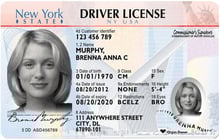
Driving while intoxicated with a passenger under 16 is an automatic felony charge - even for a first offense. Named after Leandra Rosado, an 11-year-old killed by a drunk driver in 2009. **6-Point ID System.** New York uses a point-based system for document verification. Each document (birth certificate, Social Security card, utility bill) is worth a certain number of points. You need at least 6 points total - no single document is enough. **5-Hour Pre-Licensing Course.** Before taking the road test, all applicants must complete a 5-hour pre-licensing course (minimum 270 minutes). This is separate from any driver education. Adults 18+ can complete it online.
Junior license holders under 18 cannot drive in New York City (the five boroughs) unless accompanied by a licensed driving instructor. This restriction doesn't apply to the rest of the state.

Reviewed for legal and handbook accuracy
M.S. (MIT, Columbia), Chief Educational Researcher. ACES member (Society for Editing). Verifies all 50 state tests against official handbooks weekly.

How to study for the New York permit test
- Start here. One of 4 free online New York tests. ~6 min. Read explanations as you go.
- Cover more ground. All tests have different questions - no repeats.
- Finish strong. Try the Exam Simulator for a full-length run.
Why this works
- Exam-like questions from the current handbook + questions most people get wrong. Explanations cite the manual.
- AI Assistant explains like a friend.
- Performance Insights shows where you need work.
- Challenge Bank™ saves your mistakes for targeted practice.
Sample New York permit test questions
6 questions written and verified by our content team against the current New York Driver Handbook
- Question 1 of 6
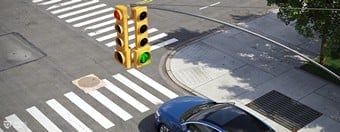
You are driving in New York City and approach a steady red traffic light. There is no sign posted permitting turns. What should you do?
Show answer & explanation
Correct answer: B - Wait for the light to turn green before making any turn
Right turns on red are prohibited in New York City unless a sign specifically permits it. Outside NYC, drivers may turn right on red after a full stop and yielding to pedestrians and traffic. This is one of the most commonly tested NYC-specific rules. (Chapter 4, "Traffic Signals," p. 30)
- Question 2 of 6
Under the "Zero Tolerance Law," a driver under 21 found with a BAC of .02 to .07 will face which penalty after the first violation?
Show answer & explanation
Correct answer: B - A 6-month license suspension and $100 suspension termination fee
The Zero Tolerance Law targets drivers under 21. A BAC between .02 and .07 triggers a 6-month suspension, a $100 suspension termination fee, and a $125 civil penalty. A second violation leads to revocation for one year or until age 21, whichever is longer. (Chapter 2, "Zero Tolerance," p. 20)
- Question 3 of 6
For vehicles driven by someone with a Class DJ learner permit, who must use a safety restraint?
Show answer & explanation
Correct answer: B - Every occupant, regardless of age or seating position
When a Class DJ learner permit holder is behind the wheel, every occupant must correctly use a safety restraint, no matter their age or where they sit. The general seat belt law is less restrictive, primarily targeting front-seat occupants and passengers under 16. (Chapter 8, "Seat Belts, Child Safety Seats, and Air Bags," p. 46)
- Question 4 of 6
A first offense for using a hand-held mobile phone while driving in New York carries a fine of up to how much, along with how many points on your driving record?
Show answer & explanation
Correct answer: C - Up to $200 and 5 points
Holding a phone to talk, listen, or make a call while driving is a traffic infraction. A first offense brings a fine of up to $200 and 5 points on your license. A second offense carries up to $250, and a third within 18 months up to $450. Drivers with probationary or junior licenses face a 120-day suspension for a first conviction. (Chapter 8, "Using a Cellular or Mobile Telephone," p. 49)
- Question 5 of 6
A 17-year-old holds a Junior License (Class DJ) and lives on Long Island (Nassau County). Between 9 PM and 5 AM, which of the following is true?
Show answer & explanation
Correct answer: B - They may drive alone directly between home and employment
Regional restrictions for Junior License holders differ by area. On Long Island (Nassau and Suffolk counties), DJ license holders may drive alone between 9 PM and 5 AM only on direct routes between home and work, a school or college course, or farm employment. NYC is more restrictive - no driving at all during those hours. Upstate counties allow solo driving between home and employment or a school course. (Chapter 1, "Regional Restrictions for a Junior License," p. 15)
- Question 6 of 6
If no speed limit is posted in New York City, what is the maximum legal speed?
Show answer & explanation
Correct answer: B - 25 mph
The NYC default speed limit is 25 mph unless a sign says otherwise. Outside the city, the general rule is 55 mph where no limit is posted. A police officer can ticket you for exceeding a limit even when no sign is visible, so knowing these defaults matters. (Chapter 8, "Speed," p. 45)
Verified by Steven Litvintchouk, M.S. (MIT), Chief Educational Researcher, on .
Real New York drivers who passed first try
Verified student reviews • Shared with permission

More New York permit test study guide & exam resources
Are you in another state?
- Alabama
- Alaska
- Arizona
- Arkansas
- California
- Colorado
- Connecticut
- Delaware
- District of Columbia
- Florida
- Georgia
- Hawaii
- Idaho
- Illinois
- Indiana
- Iowa
- Kansas
- Kentucky
- Louisiana
- Maine
- Maryland
- Massachusetts
- Michigan
- Minnesota
- Mississippi
- Missouri
- Montana
- Nebraska
- Nevada
- New Hampshire
- New Jersey
- New Mexico
- New York
- North Carolina
- North Dakota
- Ohio
- Oklahoma
- Oregon
- Pennsylvania
- Rhode Island
- South Carolina
- South Dakota
- Tennessee
- Texas
- Utah
- Vermont
- Virginia
- Washington
- West Virginia
- Wisconsin
- Wyoming
We know what it takes to pass. And we’ve got the proof.
Driver’s Ed is - nobody wants to set foot inside the DMV. That’s why millions of learners trust us for simple, visual, effective prep.
An official & trusted partner in driver education
We are an officially recognized FMCSA Entry-Level Driver Training provider and a proud partner to over 2,500 libraries. We work with safety organizations like GHSA and the National Safety Council to help create safer roads for everyone.



A smarter way to study for the permit test
Challenge Bank™
Our trademarked system automatically saves questions you miss, creating personalized tests that target your weak spots until you’ve mastered the material.
AI-powered feedback
Get smarter as you study. Our new AI-powered feedback provides detailed, question-level insights to help you understand the why behind each answer.
Interactive handbook
Go beyond the boring black-and-white manual. Our interactive handbook lets you read, listen with an MP3 audio version, or even chat with it to find the information you need, faster.
We build our practice questions from the current 2026 NY Driver Handbook and refine them using patterns recent test‑takers report.
Driver handbook • Knowledge‑test/permit overview • Fees & ID requirements • Office/appointment info
We mirror recurring themes (e.g., right‑of‑way traps, sign look‑alikes) and use similar distractors and wording styles.
We don’t collect or publish actual test items and we’re not affiliated with DMV.
- 0 Incorrect (6 allowed to pass)
- 0 Correct
Are you sure you want to restart your test?
Your test progress will be lost.