

All your missed questions are saved
automatically for extra practice.




It's a practice test that's automatically made up of all your missed questions. Once you finish this test, you’ll be able to revisit your Challenge Bank™ to practice and sharpen your skills.
View All PlansAdding difficult questions to Challenge Bank™ is an exclusive Premium feature. Unlock access to 650+ exam-like questions, a Pass Guarantee, personalized study plans, and more.
View All PlansFree Michigan DMV Permit Practice Test 2026
| 90-100 | => | 9% |
| 80-89 | => | 18% |
| 70-79 | => | 27% |
| 60-69 | => | 23% |
| <60% | => | 23% |
The Michigan knowledge test consists of 50 multiple-choice questions covering road signs, safe driving laws, and driving restrictions. You must get at least 40 questions correct to pass with a score of 80% or higher. Common mistakes include misunderstandings over road signs, mix-ups between the various types of roads related to speed limits, and not understanding the state’s graduated driver licensing program.
This Michigan permit practice test is current for May 2026 and covers the most important road signs and rules questions directly from the official 2026 MI Driver Handbook. This practice test is designed to closely mimic the format and content of the Michigan SOS knowledge test.
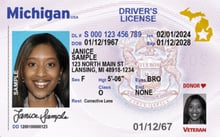
When you’re ready to apply, visit a Secretary of State office with your parent or guardian and bring proof of identity and legal U.S. presence, your Social Security number, and two proofs of Michigan residency, along with your Segment 1 Driver’s Education completion certificate. After your documents are accepted and you pass the vision screening, you’ll receive your Level 1 Learner’s License.
The Michigan learner’s permit is called the Level 1 Learner’s License and is the first stage of the state’s Graduated Driver Licensing (GDL) program for drivers under 18. To get a Level 1 license, you must first complete Segment 1 of a state-approved driver education course and be at least 14 years and 9 months old. With a Level 1 license, you may drive only with a licensed parent, legal guardian, or a designated licensed adult who is at least 21 years old seated in the front seat. You must hold Level 1 for at least six months and complete at least 50 hours of supervised driving, including 10 hours at night, before you can move on to the next stage.
At age 16, if you’ve met the Level 1 requirements (driver education, supervised driving, clean record, and a passed road skills test), you can advance to the Level 2 Intermediate License. Level 2 allows unsupervised driving but has restrictions, including no driving between 10 p.m. and 5 a.m. (with limited exceptions for work, school, or authorized activities) and a limit of one passenger under 21 who is not an immediate family member. At age 17, after holding a Level 2 license for at least six months and staying violation- and crash-free for 12 consecutive months, you can progress to a Level 3 full license with no GDL restrictions.
If you’re 18 or older, the GDL stages do not apply. You must pass the vision, knowledge, and road skills tests, but you can move directly to a full license once you meet those requirements. In Michigan, what most people call the “DMV” is officially the SOS (Secretary of State).



Michigan permit test: quick facts
What to expect at the SOS
Where Michigan test-takers struggle most
Based on 7,660 Michigan learners who practiced on our site in the last 30 days. 59% pass our practice tests, with an average first-try score of 69%.
Michigan prohibits parking within 15 feet of a fire hydrant, within 20 feet of a crosswalk, and within 30 feet of a stop sign or traffic signal. Parking on a sidewalk or in front of a driveway is also prohibited and frequently tested.
Michigan doubles fines for all moving violations committed in active construction zones. Drivers must obey posted reduced speed limits as soon as the construction zone signs appear, even if no workers are visible at that moment.
On Michigan freeways, the basic speed limit is 70 mph on rural interstates and 65 mph on urban interstates. Drivers must use the right lane except when passing, and entering or exiting a freeway must be done using on-ramps and off-ramps - stopping on a ramp is only permitted in an emergency.
Michigan law requires headlights to be on whenever windshield wipers are in use - including during light rain or drizzle. Following distances should increase to 8-10 seconds on snow or ice, compared to 3-4 seconds in normal conditions.
Michigan requires drivers to give cyclists at least 3 feet of clearance when passing. On roads with a speed limit above 35 mph, drivers passing a cyclist must change lanes entirely if a lane is available, rather than squeezing past within the same lane.
Data updated daily from our practice test results
First-try score distribution
How Michigan learners score on their first practice test attempt
Michigan-specific rules you must know
Rules that are unique to Michigan or differ from most other states
Michigan's Super Drunk Law creates a second, enhanced tier of impaired driving penalties for drivers with a BAC of 0.17% or higher. Penalties include a 180-day license suspension and mandatory ignition interlock installation. Standard OWI at 0.08-0.16% BAC carries lighter consequences, so the 0.17% threshold is a frequent test question. **50-question exam split into two sections** Michigan's knowledge test consists of 50 questions divided into two separate sections: 25 questions on traffic signs and 25 questions on traffic rules. Applicants must score at least 20 out of 25 (80%) on each section independently. Passing one section and failing the other requires retaking only the failed section.
Michigan law (MCL 257.310e) gives parents or legal guardians the explicit right to cancel or downgrade a teen's graduated license at any time before the driver turns 18. This means a parent can revoke a Level 2 license and return the teen to Level 1 permit status without any court involvement.
Michigan operates under a no-fault insurance system, meaning each driver's own insurance covers their medical expenses regardless of who caused the crash. Michigan's system offers unlimited personal injury protection (PIP) as an option - the broadest coverage available in any U.S. state - though drivers may now choose lower PIP tiers to reduce premiums.

Reviewed for legal and handbook accuracy
M.S. (MIT, Columbia), Chief Educational Researcher. ACES member (Society for Editing). Verifies all 50 state tests against official handbooks weekly.

How to study for the Michigan permit test
- Start here. One of 4 free online Michigan tests. ~6 min. Read explanations as you go.
- Cover more ground. All tests have different questions - no repeats.
- Finish strong. Try the Exam Simulator for a full-length run.
Why this works
- Exam-like questions from the current handbook + questions most people get wrong. Explanations cite the manual.
- AI Assistant explains like a friend.
- Performance Insights shows where you need work.
- Challenge Bank™ saves your mistakes for targeted practice.
Sample Michigan permit test questions
7 questions written and verified by our content team against the current Michigan Driver Handbook
- Question 1 of 7
A 16-year-old with a GDL Level 2 Intermediate License is driving with a parent in the car. Under Kelsey's Law, when can this teen legally use a hand-held cell phone while driving?
Show answer & explanation
Correct answer: B - Only to report a crash, medical emergency, serious road hazard, crime, or when personal safety is at risk
Kelsey's Law bans all hand-held cell phone use for teens holding a GDL Level 1 Learner's License or Level 2 Intermediate License. That includes initiating, answering, and listening to calls. The only exceptions are reporting crashes, medical emergencies, serious road hazards, crimes, or situations where the teen's personal safety is at risk.
Source: Ch. 4: Traffic Laws - Kelsey's Law, p. 24 - Question 2 of 7
You approach an intersection on a divided highway and want to turn left, but a sign prohibits direct left turns. How should you complete this turn using the "Michigan Left"?
Show answer & explanation
Correct answer: C - Drive straight through the intersection, make a U-turn at the median crossover beyond it, then turn right onto the cross street
The Michigan Left has been part of the state's road system since the late 1960s. At intersections that prohibit direct left turns, drivers must continue past the intersection, use a designated median crossover to make a U-turn, then come back and turn right onto the desired street. This design reduces crashes by eliminating left-turn conflicts at busy intersections.
Source: Ch. 5: Signs, Pavement Markings and Signals - Michigan Lefts, p. 48 - Question 3 of 7
Your 16-year-old just received a GDL Level 2 Intermediate License. During what hours is this driver restricted from driving without supervision?
Show answer & explanation
Correct answer: B - Between 10 PM and 5 AM
Level 2 Intermediate License holders cannot drive between 10 PM and 5 AM unless accompanied by a parent, guardian, or designated licensed adult age 21 or older, or unless driving to and from employment or another authorized activity. This restriction is separate from Kelsey's Law and applies until the teen qualifies for a Level 3 Full License at age 17.
Source: Ch. 1: Your Driver's License - GDL Level 2 Intermediate License, p. 5 - Question 4 of 7
Under Michigan's point system, how many points are added to your driving record for a drag racing conviction?
Show answer & explanation
Correct answer: C - Four points
Drag racing carries four points on your record - the same as impaired driving, driving 16+ mph over the limit, and having any bodily alcohol content while under age 21. By comparison, reckless driving and fleeing a police officer carry the maximum six points. Points stay on your record for two years from the date of conviction. Accumulating 12 or more points in a two-year period triggers a mandatory driver assessment reexamination. Being found guilty of six or more one-point violations within a two-year period also triggers a mandatory driver assessment reexamination.
Source: Ch. 2: Your Driving Record - Michigan's Point System, p. 14 - Question 5 of 7
What is the default minimum speed limit on limited-access Michigan freeways?
Show answer & explanation
Correct answer: C - 55 mph
On all limited-access Michigan freeways, the maximum speed limit is 70 mph unless posted otherwise, and the minimum speed limit is 55 mph unless posted otherwise. This means you must not drive slower than 55 mph unless safety considerations make it necessary. On 70-mph freeways, school buses and trucks are restricted to 65 mph. On freeways with speed limits below 70 mph, school buses and trucks are restricted to 55 mph.
Source: Ch. 4: Traffic Laws - Speed Limits, p. 26 - Question 6 of 7
What happens to your driver's license if you are convicted of possessing illegal drugs in Michigan, even if you were not driving at the time?
Show answer & explanation
Correct answer: C - Your license is suspended for six months on a first offense
Even possession, manufacture, or distribution of drugs - with no vehicle involved at all - triggers a six-month license suspension for a first offense. A restricted license won't be issued during the first 30 days. One or more prior drug convictions within seven years means a full year of suspension, with no restricted license for the first 60 days. The reinstatement fee is $125.
Source: Ch. 2: Your Driving Record - Alcohol and Drugs, p. 15 - Question 7 of 7
At what age or height can a child in Michigan stop using a car seat or booster seat?
Show answer & explanation
Correct answer: B - Age 8 or 4 feet 9 inches tall
Children must ride in an approved child restraint system until they turn 8 or reach 4 feet 9 inches - whichever comes first. A seat belt may not fit a smaller child correctly even if they have reached the minimum age, so the height threshold matters too. Children under age 4 must be placed in the rear seat when one is available.
Source: Ch. 4: Traffic Laws - Protecting Children and Teens, p. 25
Verified by Steven Litvintchouk, M.S. (MIT), Chief Educational Researcher, on .
Real Michigan drivers who passed first try
Verified student reviews • Shared with permission
More Michigan permit test study guide & exam resources
Are you in another state?
- Alabama
- Alaska
- Arizona
- Arkansas
- California
- Colorado
- Connecticut
- Delaware
- District of Columbia
- Florida
- Georgia
- Hawaii
- Idaho
- Illinois
- Indiana
- Iowa
- Kansas
- Kentucky
- Louisiana
- Maine
- Maryland
- Massachusetts
- Michigan
- Minnesota
- Mississippi
- Missouri
- Montana
- Nebraska
- Nevada
- New Hampshire
- New Jersey
- New Mexico
- New York
- North Carolina
- North Dakota
- Ohio
- Oklahoma
- Oregon
- Pennsylvania
- Rhode Island
- South Carolina
- South Dakota
- Tennessee
- Texas
- Utah
- Vermont
- Virginia
- Washington
- West Virginia
- Wisconsin
- Wyoming
We know what it takes to pass. And we’ve got the proof.
Driver’s Ed is - nobody wants to set foot inside the SOS. That’s why millions of learners trust us for simple, visual, effective prep.
An official & trusted partner in driver education
We are an officially recognized FMCSA Entry-Level Driver Training provider and a proud partner to over 2,500 libraries. We work with safety organizations like GHSA and the National Safety Council to help create safer roads for everyone.



A smarter way to study for the permit test
Challenge Bank™
Our trademarked system automatically saves questions you miss, creating personalized tests that target your weak spots until you’ve mastered the material.
AI-powered feedback
Get smarter as you study. Our new AI-powered feedback provides detailed, question-level insights to help you understand the why behind each answer.
Interactive handbook
Go beyond the boring black-and-white manual. Our interactive handbook lets you read, listen with an MP3 audio version, or even chat with it to find the information you need, faster.
We build our practice questions from the current 2026 MI Driver Handbook and refine them using patterns recent test‑takers report.
Driver handbook • Knowledge‑test/permit overview • Fees & ID requirements • Office/appointment info
We mirror recurring themes (e.g., right‑of‑way traps, sign look‑alikes) and use similar distractors and wording styles.
We don’t collect or publish actual test items and we’re not affiliated with SOS.
- 0 Incorrect (4 allowed to pass)
- 0 Correct
Are you sure you want to restart your test?
Your test progress will be lost.