

All your missed questions are saved
automatically for extra practice.




It's a practice test that's automatically made up of all your missed questions. Once you finish this test, you’ll be able to revisit your Challenge Bank™ to practice and sharpen your skills.
View All PlansAdding difficult questions to Challenge Bank™ is an exclusive Premium feature. Unlock access to 650+ exam-like questions, a Pass Guarantee, personalized study plans, and more.
View All PlansFree Montana Permit Practice Test 2026
| 90-100 | => | 12% |
| 80-89 | => | 19% |
| 70-79 | => | 27% |
| 60-69 | => | 24% |
| <60% | => | 18% |
To obtain a learner’s permit in Montana, you must pass a vision screening and the written permit knowledge test. The test consists of 33 multiple-choice questions covering traffic laws, signs, signals, markings, safe driving practices, driving under the influence, and sharing the road. To pass, you must answer at least 27 questions (82%) correctly.
Our free Montana MVD permit practice test – often called the written or knowledge test – is designed to prepare you for the official exam.
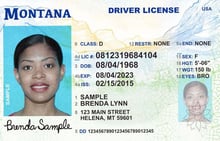
Once you’re ready, go to the Montana MVD with proof of identity (birth certificate or passport), proof of Montana residency (utility bill or rental agreement), proof of Social Security number, parental consent form if you’re under 18, and completion of traffic education if you’re under 16. Montana requires you to complete a pre-application online to streamline the process at licensing offices. Submit the documents, pass a vision screening, pay the fee, and take the official written test.
If you fail the test, you must wait 24 hours before taking it again and pay the re-test fee.
In Montana, the Graduated Driver’s License (GDL) program applies to drivers under 18. Between your 16th and 18th birthdays, you’ll be in the Restricted License phase, which allows you to drive but not between 11 PM and 5 AM unless it’s for work, school, or a church event. Except for immediate family members, you cannot carry more than one passenger under 18 during the first six months, and no more than three passengers until you turn 18.
Once you turn 18, the GDL restrictions are lifted and you obtain a standard driver’s license.



Montana permit test: quick facts
What to expect at the MVD
Where Montana test-takers struggle most
Based on 1,374 Montana learners who practiced on our site in the last 30 days. 47% pass our practice tests, with an average first-try score of 72%.
Montana has a maximum speed limit of 80 mph on certain interstates, and rules around safe following distance, lane selection, and passing on two-lane highways are heavily tested. The handbook requires a following distance of 3-4 seconds, increasing significantly in adverse conditions.
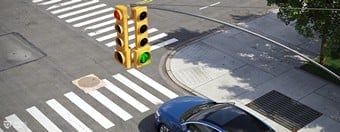
Test-takers frequently miss the distinction between flashing red (treat as stop sign) and flashing yellow (slow and proceed with caution). Montana also tests rules around protected vs. permissive left turns and what to do when traffic signals are completely out of service.
Montana is one of the only states in the US with no statewide law banning texting or handheld cell phone use while driving - which means the handbook focuses on DUI consequences and BAC thresholds rather than phone bans. The legal BAC limit is 0.08% for adults 21 and over, and 0.02% for drivers under 21.
Questions cover what to do when brakes fail, a tire blows out, or the vehicle goes into a skid. The correct response to a rear skid - steering in the direction of the skid rather than counter-steering - is a common wrong answer.
Montana has many at-grade rural crossings with limited visibility. The handbook tests required stopping distances, when you must stop versus yield, and the specific vehicle types (school buses, vehicles carrying flammable cargo) that must always stop at crossings regardless of signals.
Data updated daily from our practice test results
First-try score distribution
How Montana learners score on their first practice test attempt
Montana-specific rules you must know
Rules that are unique to Montana or differ from most other states
Montana has no law banning texting or handheld phone use while driving for the general adult population, making it one of only a handful of states without such a statute. This stands in contrast to nearly every other state, and it is worth knowing the distinction clearly if you have previously tested or driven elsewhere.
Montana issues hardship driving permits starting at age 13, the youngest legal driving age of any US state. The standard learner's permit is available at age 14.5 for teens enrolled in driver education, also among the youngest in the country - a policy driven by the state's rural geography and agricultural economy.
Montana calculates license validity based on the driver's age at renewal. Adults between 21 and 67 receive 8-year licenses. Starting at age 68, validity decreases by one year per age bracket (7 years at 68, 6 at 69, down to 1 year at 74), then returns to 4-year intervals for drivers 75 and older.

Reviewed for legal and handbook accuracy
M.S. (MIT, Columbia), Chief Educational Researcher. ACES member (Society for Editing). Verifies all 50 state tests against official handbooks weekly.

How to study for the Montana permit test
- Start here. One of 4 free online Montana tests. ~6 min. Read explanations as you go.
- Cover more ground. All tests have different questions - no repeats.
- Finish strong. Try the Exam Simulator for a full-length run.
Why this works
- Exam-like questions from the current handbook + questions most people get wrong. Explanations cite the manual.
- AI Assistant explains like a friend.
- Performance Insights shows where you need work.
- Challenge Bank™ saves your mistakes for targeted practice.
Sample Montana permit test questions
5 questions written and verified by our content team against the current Montana Driver Handbook
- Question 1 of 5
What is the daytime speed limit for cars and light trucks on a two-lane highway in Montana?
Show answer & explanation
Correct answer: B - 70 mph
On two-lane highways, the daytime speed limit for cars and light trucks is 70 mph. At night, it drops to 65 mph. For such purposes, Montana considers "nighttime" to be from a half hour after sunset to a half hour before sunrise.
- Question 2 of 5
By how much may a driver exceed the speed limit when passing another vehicle on a two-lane road in Montana?
Show answer & explanation
Correct answer: B - 10 mph
Drivers traveling on a two-lane road may exceed the speed limit by 10 miles an hour when overtaking and passing another vehicle. The extra speed helps reduce time spent in the opposing lane. (Of course, drivers must not pass at all in a no-passing zone.) Most other states do not grant any speed-limit exception for passing.
- Question 3 of 5
Under Montana's Graduated Driver Licensing program, when are first-year restricted license holders prohibited from driving?
Show answer & explanation
Correct answer: C - Between 11:00 PM and 5:00 AM
Teenage drivers with a first-year restricted license may not drive between 11:00 PM and 5:00 AM. Limited exceptions include emergencies, farm-related activities, travel to and from school, church, or work, and purposes specifically authorized by a parent or guardian. Law enforcement may contact the parent to verify authorization.
- Question 4 of 5
On highways with a posted speed limit of 50 mph or more, how much must you slow down when passing a stationary emergency vehicle with flashing lights?
Show answer & explanation
Correct answer: C - Slow to at least 20 mph below the posted speed limit
On highways with a posted speed limit of 50 mph or more, vehicles in a lane directly next to a stationary emergency or police vehicle displaying emergency signals must slow down to at least 20 mph below the posted speed limit. When possible, drivers should also switch to a lane farther away from the stopped vehicle.
- Question 5 of 5
How far in advance must you activate your turn signal before turning on a rural road in Montana?
Show answer & explanation
Correct answer: C - 300 feet
State law requires a turn signal at least 100 feet before turning in town and 300 feet before turning on rural roads. The longer distance outside of town accounts for higher travel speeds - other drivers need more time to see your signal and react.
Verified by Steven Litvintchouk, M.S. (MIT), Chief Educational Researcher, on .
Real Montana drivers who passed first try
Verified student reviews • Shared with permission

More Montana permit test study guide & exam resources
Are you in another state?
- Alabama
- Alaska
- Arizona
- Arkansas
- California
- Colorado
- Connecticut
- Delaware
- District of Columbia
- Florida
- Georgia
- Hawaii
- Idaho
- Illinois
- Indiana
- Iowa
- Kansas
- Kentucky
- Louisiana
- Maine
- Maryland
- Massachusetts
- Michigan
- Minnesota
- Mississippi
- Missouri
- Montana
- Nebraska
- Nevada
- New Hampshire
- New Jersey
- New Mexico
- New York
- North Carolina
- North Dakota
- Ohio
- Oklahoma
- Oregon
- Pennsylvania
- Rhode Island
- South Carolina
- South Dakota
- Tennessee
- Texas
- Utah
- Vermont
- Virginia
- Washington
- West Virginia
- Wisconsin
- Wyoming
We know what it takes to pass. And we’ve got the proof.
Driver’s Ed is - nobody wants to set foot inside the MVD. That’s why millions of learners trust us for simple, visual, effective prep.
An official & trusted partner in driver education
We are an officially recognized FMCSA Entry-Level Driver Training provider and a proud partner to over 2,500 libraries. We work with safety organizations like GHSA and the National Safety Council to help create safer roads for everyone.



A smarter way to study for the permit test
Challenge Bank™
Our trademarked system automatically saves questions you miss, creating personalized tests that target your weak spots until you’ve mastered the material.
AI-powered feedback
Get smarter as you study. Our new AI-powered feedback provides detailed, question-level insights to help you understand the why behind each answer.
Interactive handbook
Go beyond the boring black-and-white manual. Our interactive handbook lets you read, listen with an MP3 audio version, or even chat with it to find the information you need, faster.
We build our practice questions from the current 2026 MT Driver Handbook and refine them using patterns recent test‑takers report.
Driver handbook • Knowledge‑test/permit overview • Fees & ID requirements • Office/appointment info
We mirror recurring themes (e.g., right‑of‑way traps, sign look‑alikes) and use similar distractors and wording styles.
We don’t collect or publish actual test items and we’re not affiliated with MVD.
- 0 Incorrect (4 allowed to pass)
- 0 Correct

Are you sure you want to restart your test?
Your test progress will be lost.