

All your missed questions are saved
automatically for extra practice.
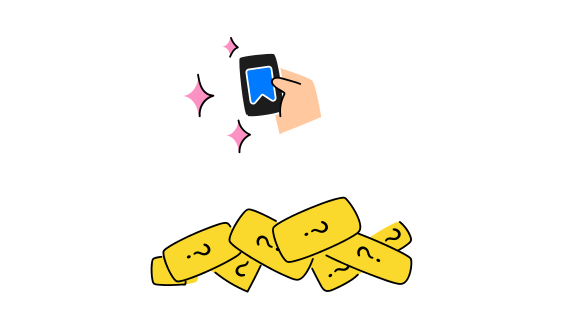



It's a practice test that's automatically made up of all your missed questions. Once you finish this test, you’ll be able to revisit your Challenge Bank™ to practice and sharpen your skills.
View All PlansAdding difficult questions to Challenge Bank™ is an exclusive Premium feature. Unlock access to 650+ exam-like questions, a Pass Guarantee, personalized study plans, and more.
View All PlansFree California DMV Permit Practice Test 2026 | CA
| 90-100 | => | 16% |
| 80-89 | => | 31% |
| 70-79 | => | 28% |
| 60-69 | => | 16% |
| <60% | => | 8% |
To get your California DMV instruction permit, you must be at least 15½ years old, complete a driver education program if you’re under 18, and pass a vision screening and the DMV written test. The permit test consists of 46 multiple-choice questions covering information outlined in the state’s California DMV 2026 Driver’s Manual. To pass, you must score at least 83% (38 out of 46 questions).
Our free California DMV permit practice test mimics the official knowledge test and provides immediate feedback on missed questions to speed the learning experience.
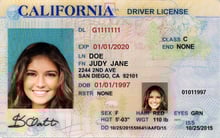
Once you’re ready to apply for the permit, go to the DMV with proof of identity (birth certificate, passport), Social Security card, two proofs of residence (utility bill, bank statement), any legal name change documents, and completed application. If under 18, you’ll need signed consent (in person) from a parent or legal guardian and a certificate of driver’s education completion. Submit the documents, pass a vision screening, pay the fee, and pass the official written test.
If you’re a minor (under 18) and fail, you must wait seven days before retaking it (not including the day you failed).
The Instruction Permit is the first phase of California’s Graduated Driver’s License (GDL) program for drivers under 18. At age 15½, teens can apply after completing a driver education course and at least 6 hours of professional driver training. During this stage, teens are allowed to drive when accompanied by a parent or guardian, a licensed driver 25 years old or older, or a certified driving instructor. At age 16, after holding the permit for at least 6 months and completing 50 hours of supervised driving (including 10 hours at night), teens can take the driving test to get a provisional license. This license comes with drive time and passenger restrictions for the first 12 months. After the 12-month period has passed, or they turn 18, they can obtain an unrestricted license.
If you’re 18 or older, the GDL phases do not apply. You must apply for your instruction permit as detailed above, but you can take the road skills test whenever you feel ready. Upon passing, you will obtain your unrestricted license.



California permit test: quick facts
What to expect at the DMV
Where California test-takers struggle most
Based on 39,014 California learners who practiced on our site in the last 30 days. 53% pass our practice tests, with an average first-try score of 78%.
Check mirrors, signal, check blind spot, then change lanes. California has "turnout" areas on two-lane roads - slower vehicles must use them when five or more vehicles are following. On a multi-lane highway, the left lane is for passing and faster traffic. It is illegal to cross double solid yellow lines to pass.
When entering a freeway, use the acceleration lane to match traffic speed before merging. HOV lanes (carpool lanes) require 2+ occupants unless you have a qualifying clean-air vehicle sticker. The minimum speed on a California freeway is typically 45-50 mph unless posted otherwise.
A yellow diamond sign with an arrow curving left warns of a curve ahead. Advisory speed signs (posted below warning signs) recommend a safe speed for the condition shown. A yellow pennant shape on the left side of the road means No Passing Zone. Orange signs indicate construction zones - fines double in active work zones.
Tule fog in the Central Valley can reduce visibility to near zero - use low-beam headlights and reduce speed. If you can't see the road, pull completely off the roadway and wait. When roads are first wet after a dry spell, they are most slippery. In heavy rain, follow other vehicles' tire tracks.
California's zero-tolerance law sets the BAC limit at 0.01% for drivers under 21 - stricter than the 0.02% used in many states. Refusing a chemical test after a DUI arrest results in automatic one-year license suspension (implied consent). A hit-and-run causing injury is a felony punishable by up to 4 years in prison.
Data updated daily from our practice test results
First-try score distribution
How California learners score on their first practice test attempt
California-specific rules you must know
Rules that are unique to California or differ from most other states
All drivers must use hands-free devices for phone calls. Holding a phone to your ear while driving is a primary offense. For drivers under 18, all wireless device use is prohibited, including hands-free.
California's limit for under-21 drivers is 0.01% - effectively any measurable amount. Most states set this at 0.02%.
California requires 15/30/5 coverage: $15,000 per person for injuries, $30,000 total for all injuries per crash, $5,000 for property damage. These are among the lowest minimums in the country.
All vehicles must pass a biennial smog check. New vehicles are exempt for the first 6 years. This is tested on the written exam because it's a condition of vehicle registration.

Reviewed for legal and handbook accuracy
M.S. (MIT, Columbia), Chief Educational Researcher. ACES member (Society for Editing). Verifies all 50 state tests against official handbooks weekly.

How to study for the California permit test
- Start here. One of 4 free online California tests. ~6 min. Read explanations as you go.
- Cover more ground. All tests have different questions - no repeats.
- Finish strong. Try the Exam Simulator for a full-length run.
Why this works
- Exam-like questions from the current handbook + questions most people get wrong. Explanations cite the manual.
- AI Assistant explains like a friend.
- Performance Insights shows where you need work.
- Challenge Bank™ saves your mistakes for targeted practice.
Sample California permit test questions
6 questions written and verified by our content team against the current California Driver Handbook
- Question 1 of 6
During the first 12 months of holding a provisional driver's license, when are you prohibited from driving without a licensed adult in the vehicle?
Show answer & explanation
Correct answer: B - Between 11 p.m. and 5 a.m.
For the first 12 months, provisional license holders cannot drive between 11 p.m. and 5 a.m. unless accompanied by a parent, guardian, or a licensed driver who is at least 25 years old. Exceptions exist for medical needs, school activities, work, or driving an immediate family member - but you must carry a signed note explaining the reason.
Source: CA Driver Handbook, Section 2 - Minor's Restrictions and Exceptions - Question 2 of 6
Under California law, what cell phone use is permitted for drivers under 18?
Show answer & explanation
Correct answer: C - No cell phone use at all, except to call for emergency assistance
Drivers under 18 face a near-total ban on cell phone use while driving. Adults may use hands-free features and single-tap controls on a mounted phone, but minors cannot use a phone or wireless device in any mode. The only exception is making an emergency call. Handheld or hands-free, it doesn't matter.
Source: CA Driver Handbook, Section 8 - Minors and Cell Phones - Question 3 of 6
When passing a bicyclist on the road, what is the minimum clearance California law requires between your vehicle and the bicycle?
Show answer & explanation
Correct answer: C - Three feet
You must leave at least three feet of space when passing a bicyclist. If you cannot provide that clearance, do not pass until you safely can. This applies whether you change lanes or stay in the same lane. Drivers should also watch for cyclists before opening doors, merging toward curbs, or entering bike lanes - you may only drive in a bike lane within 200 feet of a turn.
Source: CA Driver Handbook, Section 7 - Sharing the Road: Passing a Bicyclist - Question 4 of 6
What does California law say about motorcycle lane splitting - riding between lanes of traffic moving in the same direction?
Show answer & explanation
Correct answer: C - It is legal
Lane splitting is legal in California. Drivers should never try to pass a motorcycle in the same lane and should give motorcycles the full lane whenever possible. When you can, move to one side of your lane to give motorcyclists room to pass safely.
Source: CA Driver Handbook, Section 7 - Sharing the Road: Motorcycles - Question 5 of 6
Under the Move Over and Slow Down law, which of the following vehicles must you move over and slow down for when they are stopped with flashing lights?
Show answer & explanation
Correct answer: C - Stationary emergency vehicles and tow trucks displaying flashing amber lights
The law covers more than just traditional emergency vehicles. Drivers must move over and slow down for stationary emergency vehicles or tow trucks displaying flashing amber warning lights, as well as stopped road work vehicles with emergency flashing or amber warning lights. Failure to comply can result in a ticket.
Source: CA Driver Handbook, Section 7 - Sharing the Road: Move Over and Slow Down - Question 6 of 6
When is it legal to make a left turn against a red traffic signal light in California?
Show answer & explanation
Correct answer: D - When turning from a one-way street onto a one-way street, after stopping and yielding
Most drivers know about right turns on red, but few realize left turns on red are also allowed in one specific situation. You may turn left from a one-way street onto a one-way street at a red light after coming to a complete stop. Before turning, make sure no sign prohibits the move, then yield to other vehicles, pedestrians, and bicyclists who have a green light. Look both ways and turn only when safe.
Source: CA Driver Handbook, Section 6 - Turns: Left Turn Against a Red Light
Verified by Steven Litvintchouk, M.S. (MIT), Chief Educational Researcher, on .
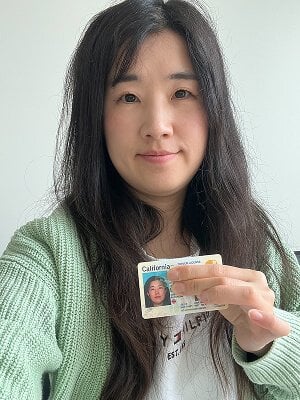
Real California drivers who passed first try
Verified student reviews • Shared with permission
More California permit test study guide & exam resources
Are you in another state?
- Alabama
- Alaska
- Arizona
- Arkansas
- California
- Colorado
- Connecticut
- Delaware
- District of Columbia
- Florida
- Georgia
- Hawaii
- Idaho
- Illinois
- Indiana
- Iowa
- Kansas
- Kentucky
- Louisiana
- Maine
- Maryland
- Massachusetts
- Michigan
- Minnesota
- Mississippi
- Missouri
- Montana
- Nebraska
- Nevada
- New Hampshire
- New Jersey
- New Mexico
- New York
- North Carolina
- North Dakota
- Ohio
- Oklahoma
- Oregon
- Pennsylvania
- Rhode Island
- South Carolina
- South Dakota
- Tennessee
- Texas
- Utah
- Vermont
- Virginia
- Washington
- West Virginia
- Wisconsin
- Wyoming
We know what it takes to pass. And we’ve got the proof.
Driver’s Ed is - nobody wants to set foot inside the DMV. That’s why millions of learners trust us for simple, visual, effective prep.
An official & trusted partner in driver education
We are an officially recognized FMCSA Entry-Level Driver Training provider and a proud partner to over 2,500 libraries. We work with safety organizations like GHSA and the National Safety Council to help create safer roads for everyone.



A smarter way to study for the permit test
Challenge Bank™
Our trademarked system automatically saves questions you miss, creating personalized tests that target your weak spots until you’ve mastered the material.
AI-powered feedback
Get smarter as you study. Our new AI-powered feedback provides detailed, question-level insights to help you understand the why behind each answer.
Interactive handbook
Go beyond the boring black-and-white manual. Our interactive handbook lets you read, listen with an MP3 audio version, or even chat with it to find the information you need, faster.
We build our practice questions from the current 2026 CA Driver Handbook and refine them using patterns recent test‑takers report.
Driver handbook • Knowledge‑test/permit overview • Fees & ID requirements • Office/appointment info
We mirror recurring themes (e.g., right‑of‑way traps, sign look‑alikes) and use similar distractors and wording styles.
We don’t collect or publish actual test items and we’re not affiliated with DMV.
- 0 Incorrect (3 allowed to pass)
- 0 Correct
Are you sure you want to restart your test?
Your test progress will be lost.